Key Takeaways
- PCR cosmetic packaging isn’t a fit for every product. PCR cosmetic packaging works on the right materials and percentages for your formula, budget, and look, so the real question is where it fits your range, not whether to use it everywhere.
- PCR works best on PP and PE. That covers PP bottles, PP inner bottles in airless packaging, and PE tubes, which together fit most skincare lines.
- 30% PCR is the practical sweet spot. At 30% the packaging looks the same as virgin plastic to the eye, while meeting the recycled-content thresholds most regulations are converging on.
- Higher isn’t always better. Pushing toward 100% can bring a gray or yellow tint, color-matching difficulty, and more brittle parts, so the right level depends on your product, not on the biggest number.
- Done right, PCR cosmetic packaging pays you back. It opens retail shelves that now require recycled content, supports a premium price, and gives values-driven shoppers a reason to choose you and come back, turning a packaging decision into a brand and sales advantage.
Last Updated: June 2026
You want to put recycled content in your packaging, and then the questions start. Can my product even use PCR? Will it look gray or cheap? Is it safe next to my formula? Is it worth the extra cost, or am I just paying more to feel good? And if I make a recycled-content claim, can it hold up?
Those are the right questions, and most guides on PCR cosmetic packaging skip past them to tell you it’s good for the planet. Here’s the more useful truth: PCR isn’t a single decision you make once for your whole brand. It’s a product-by-product choice that depends on your material, your formula, your budget, and the look you’re going for. Get it right and recycled content becomes one of the most practical sustainability moves you can make, the kind that opens retail doors, supports a premium, and gives loyal customers a reason to keep choosing you. Get it wrong and it brings color problems, cost, and headaches. This article walks through where PCR cosmetic packaging fits, where it doesn’t, and what it actually does for a brand that gets it right, so you can decide with confidence instead of guesswork.
Which of Your Products Can Actually Use PCR
PCR works reliably on PP and PE, which in practice means PP bottles, the PP inner bottles used in airless packaging, and PE cosmetic tubes, because these are the resins with a stable, cost-effective recycled supply. The first question with PCR cosmetic packaging isn’t how much to use, it’s whether your packaging is made from a material that takes PCR well in the first place.
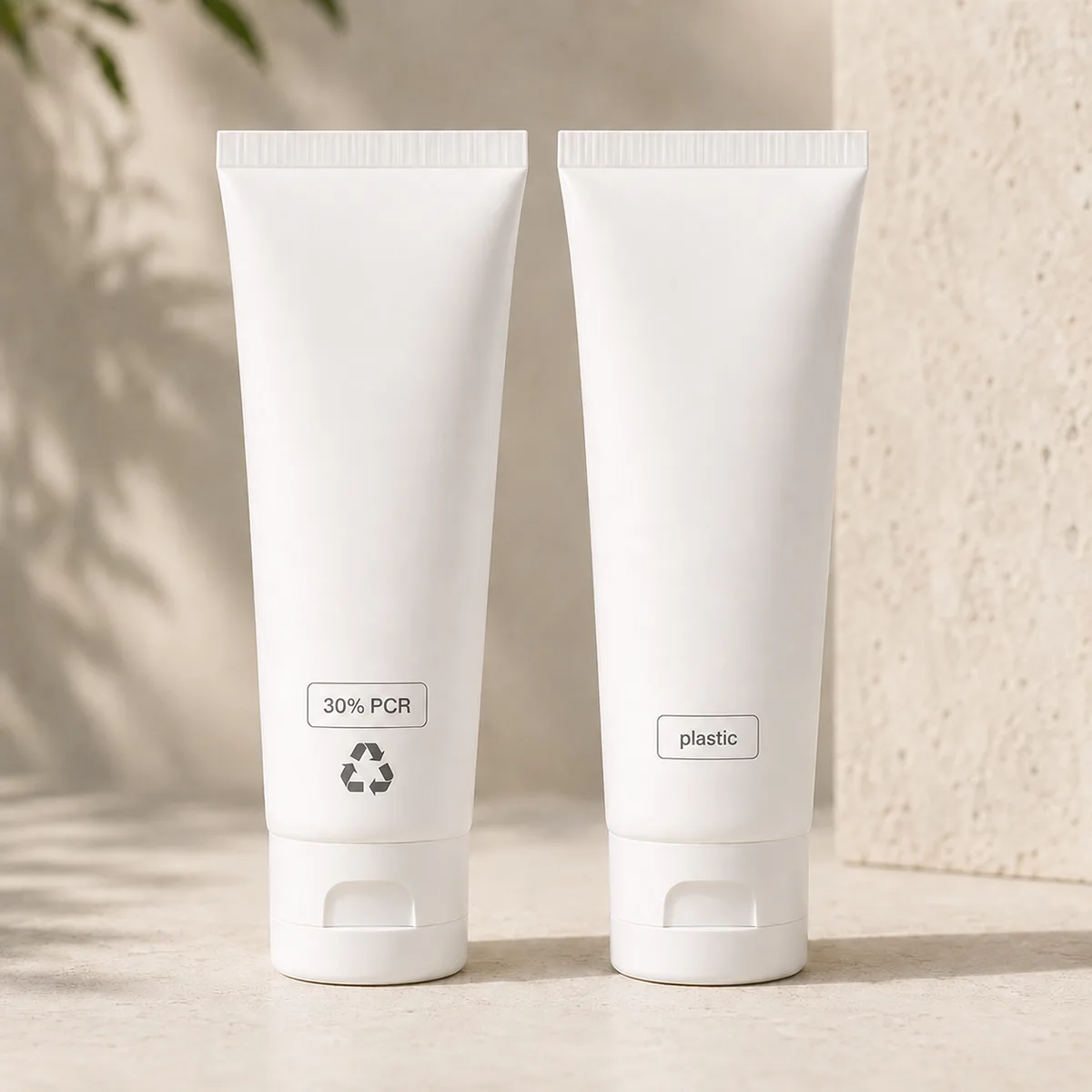
Here’s the honest breakdown, because matching PCR to the right material is what prevents problems down the line:
- PP bottles and PP inner bottles. Polypropylene handles recycled content well and resists the oils and actives common in skincare. This makes PP a strong candidate for PCR, including the PP inner bottle inside an airless system, where the recycled content sits in the structural part of the pack.
- PE tubes. Almost every cosmetic squeeze tube is made from PE, and PE takes PCR well, so tubes are one of the most practical places to add recycled content across a skincare range.
- Where it’s not a fit. Not every component or product suits PCR. Functional parts like fine pump mechanisms, springs, or certain caps rely on precise material performance, and some designs, especially anything needing perfect glass-like clarity, are better left in virgin material. This isn’t a limitation to hide, it’s the kind of judgment that protects your launch.
So PCR isn’t all-or-nothing across your brand. A practical approach is to add recycled content where it performs well, like your PP bottles and PE tubes, and keep virgin material where function or appearance demands it. That mix gives you a real, honest sustainability gain without forcing PCR somewhere it will cause trouble.
The 30% Sweet Spot: Why More Isn’t Always Better
For most skincare packaging, 30% PCR is the practical sweet spot, because at that level the packaging looks essentially the same as virgin plastic while still meeting the recycled-content thresholds regulations are moving toward. The instinct to go as high as possible is understandable, but in practice it often works against you.
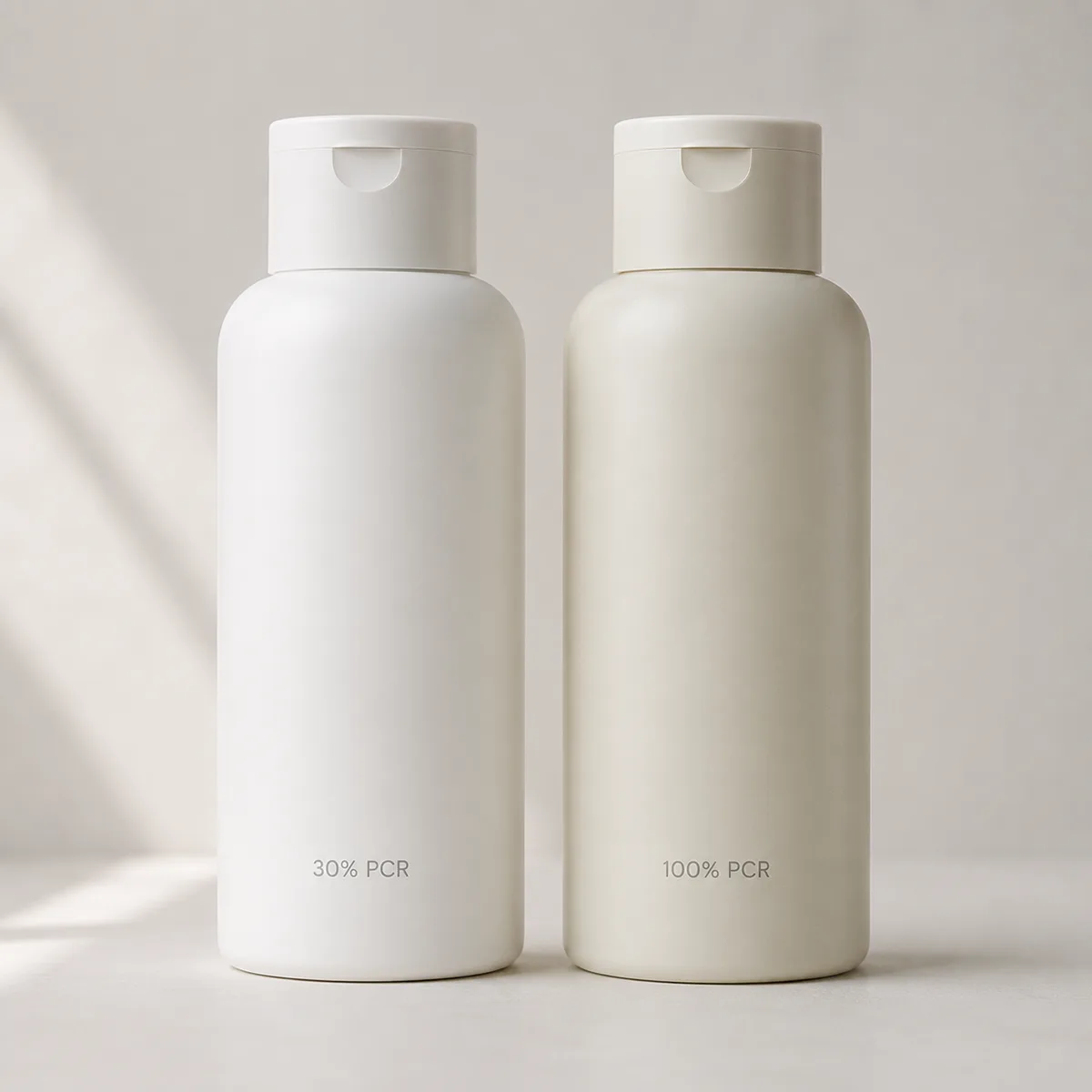
Here’s what actually happens as you raise the percentage, and why 30% tends to be the smart default:
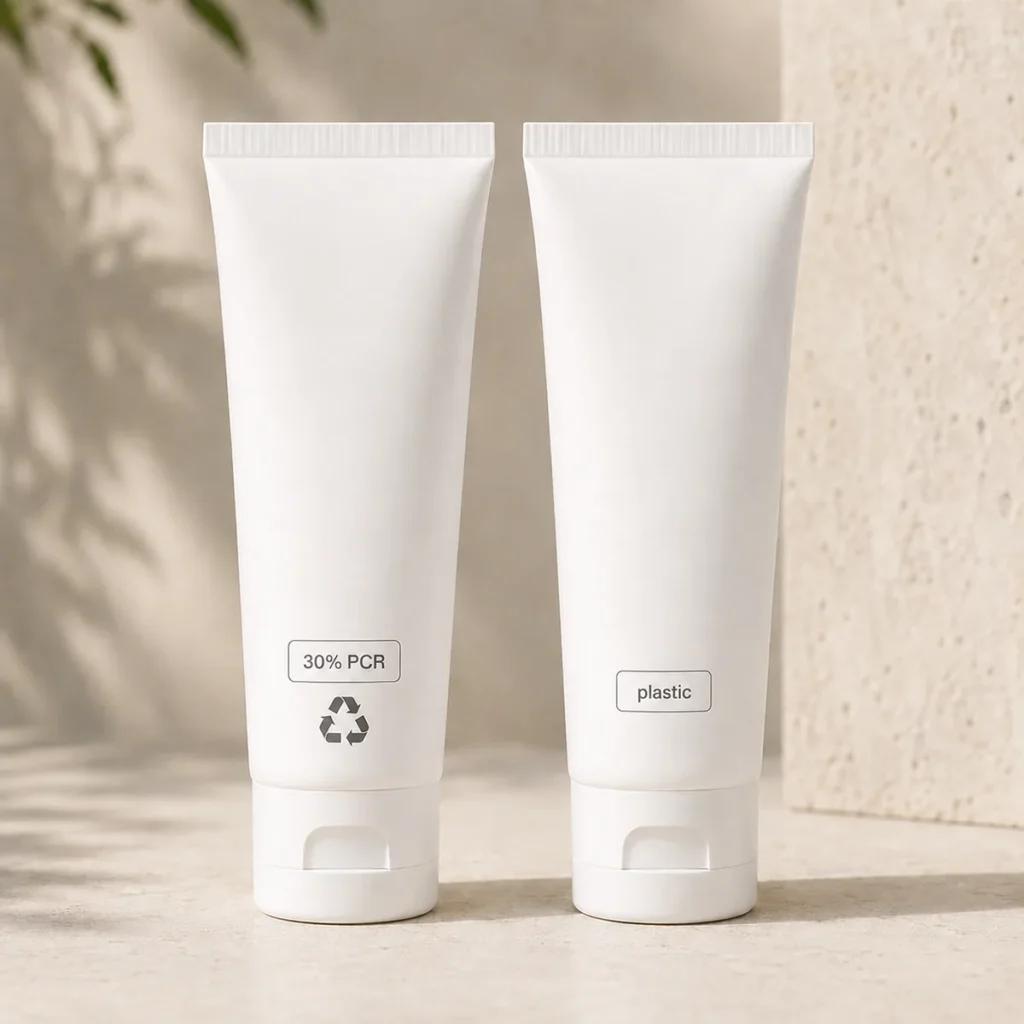
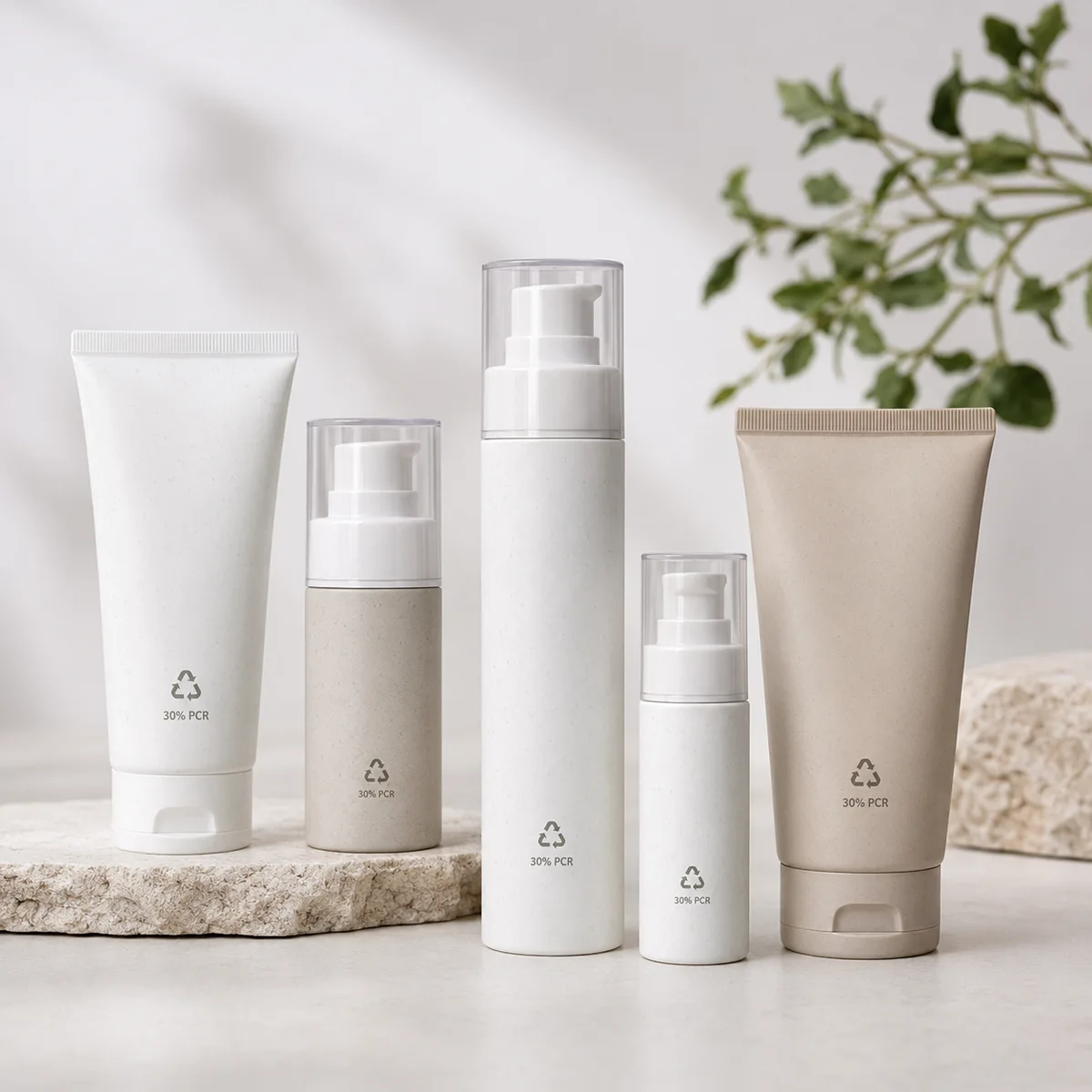
- At 30%, the look is the same. A tube or bottle with 30% PCR is, to the eye, indistinguishable from one made with virgin plastic. There’s no visible gray or yellow tint and no compromise on a clean, premium appearance. Because the difference can’t be seen, brands usually mark the recycled content directly on the pack so customers know it’s there.
- Pushing higher introduces real trade-offs. As PCR content climbs toward 100%, a gray or yellow tint becomes harder to avoid, color matching gets less reliable, and parts can become more brittle. For a light-colored or premium design, that can mean a product that looks off on the shelf, which is the opposite of what you wanted.
- High PCR can still be right for some looks. A brand built around a hardcore zero-waste story, using dark or matte colors that hide tint, can make higher percentages work. The point isn’t that high PCR is bad, it’s that the right level depends on your color, your design, and your positioning, not on chasing the biggest number.
30% gives most brands the honest environmental gain and the regulatory tick without asking them to sacrifice how the product looks. That balance is exactly why it’s become the most common starting point.
Is PCR Safe Next to Your Formula?
Yes, PCR can be used safely with cosmetic formulas, and for sensitive products the most reliable approach is a multi-layer (ABA) structure, where virgin material forms the inner layer that touches the product and PCR sits in the middle. Formula safety is the concern that stops a lot of brands, and it has a straightforward answer.
What’s worth understanding so you can decide with confidence:
- Multi-layer construction keeps virgin material against the formula. In an ABA structure, the layer in contact with your product is virgin resin, while the recycled content lives in the middle. You get the environmental benefit of PCR without recycled material touching the formula, which addresses the migration concern directly.
- Match the material to the formula. Active or high-oil formulas deserve a compatibility check, the same as with virgin packaging. PP’s chemical resistance makes it well suited to the oils and actives common in skincare, which is part of why it’s a reliable base for PCR.
- Always test before bulk. A fill and compatibility test with your actual formula confirms everything works together before you commit to a full run. That one step protects both your product and your launch.
Certification and Compliance: Making Your Claim Hold Up
With PCR cosmetic packaging, a recycled-content claim is only as good as the certification behind it, which is why credible PCR packaging comes with traceable documentation like GRS, and why 30% has become a meaningful compliance line. This is the part that turns a nice-sounding green claim into one that survives scrutiny at the border and on the shelf.
- Traceable certification protects you. Certification such as the Global Recycled Standard (GRS) documents that recycled content genuinely comes from post-consumer sources. Without that paper trail, a PCR claim can be challenged as greenwashing, and uncertified material can run into customs problems in the EU and North America. Verifiable material is what lets you make a specific claim, like “30% post-consumer recycled,” and stand behind it.
- Regulation is converging on recycled content. Rules across the EU and US states are tightening minimum recycled-content requirements, and 30% sits at a practical threshold many of them are moving toward. Industry bodies like the Association of Plastic Recyclers set the recycled-content standards that underpin these claims. Building it in now is cheaper than a forced redesign later.
- Say it clearly on pack. Because 30% PCR is invisible to the eye, the recycled content only counts with customers if they can see it stated. Marking the percentage on the pack and your product page turns the material choice into a claim shoppers can actually act on.
Not sure whether PCR fits your product and budget? Tell us your packaging type and formula, and we’ll tell you honestly where recycled content works for you, at what percentage, with a free sample to see and feel before you commit.
What PCR Actually Does for Your Brand
Beyond reducing plastic, PCR cosmetic packaging does four concrete things for a brand: it keeps you compliant, it unlocks retail shelves that now require recycled content, it gives shoppers a reason to choose you over a near-identical competitor, and it deepens the loyalty that drives repeat sales. This is the return on PCR cosmetic packaging that makes the effort worth it, and it’s the part most material guides leave out.
It unlocks retail shelves you can’t reach without it. This is the most direct sales impact, and it’s not theoretical. Major beauty retailers have built recycled content into their sustainability programs as a hard requirement, not a nice-to-have. Ulta’s Conscious Beauty program asks that a brand’s packaging be at least 50% recycled or bio-sourced material, recyclable, or refillable to qualify for its sustainable-packaging recognition. Sephora’s Planet Aware seal sets responsible-packaging criteria a brand has to meet. Clean-beauty retailer Credo has required its brand partners to move to recycled or sustainable materials. For an indie brand, getting onto a shelf like this can be a turning point in its growth, and recycled content is often part of the price of admission. That makes PCR a direct route to customers and orders you simply couldn’t reach otherwise.
PCR cosmetic packaging keeps you compliant and ahead of cost. Meeting recycled-content thresholds now means avoiding forced redesigns and possible penalties as regulations tighten across the EU and US markets. Building 30% in today is far cheaper than re-tooling your packaging under deadline pressure later. That’s real money protected, and a launch calendar that doesn’t get derailed by a rule change.
It gives shoppers a reason to pick you, and to come back. A growing share of beauty buyers, especially younger ones, actively look for sustainability before they buy, and many say they’ll pay a little more for it. When a customer is choosing between your product and a near-identical competitor on a shelf or a search results page, a credible recycled-content claim can be the tiebreaker. And because the shoppers who buy for their values tend to stay loyal to brands that share them, that first choice often becomes a repeat one. In a category where winning a new customer is expensive and a loyal one is gold, that repeat behavior is where the real profit sits.
It gives your brand a real story to tell. Shoppers increasingly want products they feel good about buying, not just products that work, and recycled content gives you something concrete to say. Marked clearly on the pack and carried through to your product page and social feed, a “30% post-consumer recycled” claim turns packaging into a talking point your customers will repeat for you. That’s word of mouth and social proof that brings new buyers in at no media cost, and it’s far more believable than a vague “eco-friendly” label because it’s backed by a specific, verifiable number.
It builds the brand itself. Used consistently across your range and stated honestly, recycled content stops being a material spec and becomes part of your brand’s identity, the kind of substance behind a sustainability claim that earns lasting trust. A believable green story is an asset that compounds: it supports your price, your shelf presence, and your reputation all at once.
Seen this way, PCR cosmetic packaging in the right places isn’t a cost you absorb to look responsible. It’s an investment in shelf access, compliance, premium positioning, and loyalty, the things that help a brand sell more, charge more, and grow. That’s why it’s worth doing deliberately, product by product, rather than all at once or not at all.
Choosing and Ordering PCR Packaging
The practical path with PCR cosmetic packaging is to add it where it performs, usually starting at 30%, confirm color and compatibility with a sample, and back the recycled content with certification, on a typical timeline of around 12–15 working days for sampling and 30–40 days for production. Getting it right is less about ambition and more about matching the choice to each product.
What to keep in mind as you move from idea to order:
- Start where PCR fits. Add recycled content to your PP bottles and PE tubes first, and keep virgin material where function or clarity needs it. 30% is the sensible starting percentage for most brands.
- Sample before bulk. Because color and feel matter, confirm them on a real sample, and run a compatibility check with your formula. It protects your investment and your launch.
- Ask for certification. Make sure the recycled content is backed by traceable documentation so your claim holds up with retailers, regulators, and customers.
LumLun, a B2B OEM cosmetic packaging manufacturer working with skincare brands across 27 countries, approaches PCR the way a brand owner has to: honestly, product by product. That tends to show up in how a project runs:
- Free samples shipped within 48 hours, so you can see and feel the recycled content before committing.
- Replies within 2 hours, so a sourcing decision doesn’t stall.
- An honest read on fit, telling you where PCR works for your product and where it doesn’t, rather than pushing it everywhere.
One honest note, because the right choice depends on the product: PCR cosmetic packaging isn’t the only sustainable route, and it isn’t right for every formula or budget. If your product needs perfect clarity, or your formula is highly sensitive, options like a virgin-contact multi-layer structure, a sustainable tube in PE or sugarcane-based material, or a refillable airless design may serve you better. Matching the solution to the product is the whole point.
Thinking about PCR for your packaging?
Tell us your product, material, and the claim you want to make, and we’ll tell you honestly where PCR fits, at what percentage, with free samples shipped in 48 hours.
Frequently Asked Questions
Which cosmetic products can use PCR packaging?
PCR works best on PP and PE, so PP bottles, the PP inner bottles in airless packaging, and PE tubes are the most practical fits. These resins have a stable recycled supply and perform reliably. Functional parts like fine pumps and certain caps, or designs needing perfect clarity, are usually better in virgin material. The right approach is to add PCR where it performs and keep virgin material where function or appearance demands it.
Does PCR make packaging look gray or cheap?
Not at 30%, which is why it’s the most common level. At 30% PCR, the packaging looks the same as virgin plastic to the eye, with no visible gray or yellow tint. The tint and color-matching issues appear as content climbs toward 100%. Because 30% is invisible, brands usually mark the recycled percentage on the pack so customers know the sustainability is there.
Is PCR safe for skincare formulas?
Yes, especially with a multi-layer structure that keeps virgin material against the product. In an ABA construction, the inner layer touching your formula is virgin resin while PCR sits in the middle, which addresses migration concerns directly. As with any packaging, active or high-oil formulas should get a compatibility test before bulk. PP’s chemical resistance makes it a reliable base for recycled content in skincare.
What PCR percentage should I choose?
For most brands, 30% is the practical starting point. It looks identical to virgin plastic, meets the recycled-content thresholds regulations are converging on, and avoids the tint and brittleness that come with very high percentages. Higher levels can suit dark or matte designs and hardcore sustainability positioning. The right percentage depends on your color, design, and brand story, not on the biggest number.
Can PCR packaging actually help my brand sell more?
Yes, mainly by opening retail access and strengthening loyalty. Major beauty retailers like Ulta, Sephora, and Credo now build recycled content into their sustainability programs, so PCR can be the price of admission to shelves you couldn’t reach otherwise. It also gives values-driven shoppers a reason to choose you over a near-identical competitor and to come back, which is where repeat sales and real profit come from.
Is PCR worth the extra cost?
For many brands, yes, because it returns more than it costs. PCR runs a premium over virgin plastic, but it keeps you compliant as regulations tighten, opens retail doors that require recycled content, and gives values-driven shoppers a reason to choose you. The right comparison isn’t cost versus zero, it’s the premium against the access, compliance, and loyalty it brings, weighed against your own budget and goals.