When sourcing a supplement bottle, it is easy to start with capacity: 50ml, 80ml, 100ml or 140ml. But if the product is capsules, the bottle’s mL figure does not answer the most important question: will the planned capsule count fit, and will the finished pack have the right internal and visual proportion?
A more useful sequence starts with the contents. First establish how large the capsules are and how many go into each bottle. Then compare bottle capacity and real bottle models.
The reason is simple: the same number of capsules can occupy very different space when the individual capsule size changes. “60 capsules” is not a complete bottle specification. “60 capsules of what size?” is where bottle selection really begins.
Start with capsule size, not 50ml or 100ml
A supplement bottle is described by container capacity, while capsules have their own dimensions. For common two-piece hard capsules, sizes such as 000, 00, 0 and 1 represent different capsule dimensions. A larger capsule occupies more space in the bottle than a smaller one.
That means 60 larger hard capsules and 60 smaller hard capsules do not automatically need the same bottle space. This is why a question such as “How many capsules fit in a 100ml supplement bottle?” is still missing one important piece of information: the capsule size.
Once capsule size and target count are considered together, bottle capacity becomes much more meaningful. The examples below are based mainly on common two-piece hard capsules. If the project uses softgels or another shape, the actual product dimensions are more useful than applying a hard-capsule size code that does not describe the product.
Why can the same 60-capsule count need a different bottle size?
Imagine two products that both contain 60 capsules. One uses relatively small hard capsules; the other uses visibly larger capsules. The retail count is identical, but the total space occupied by the two groups is not.
Packer-bottle reference charts therefore normally combine capsule size × capsule count × bottle size rather than looking at count alone.

For example, one industry bottle-size chart gives the following reference points for 60 common hard capsules:
| Capsule size | Industry bottle-size reference for 60 capsules |
|---|---|
| Size 1 | about 100 cc |
| Size 0 | about 120 cc |
| Size 00 | about 180 cc |
| Size 000 | about 200 cc |
Industry reference: TricorBraun’s capsule and pill bottle size chart. The figures above illustrate why capsule size changes the bottle-size starting point; they are not guaranteed fill counts for a specific LumLun model.
In other words, “60” tells you how many pieces the bottle must hold, while capsule size tells you how large those pieces are. Both matter.
Why can’t capsule count be converted mechanically into mL?
Capsules do not fill a bottle like a liquid. There are gaps between capsules, individual capsules settle in different orientations, and the shoulder, base and overall bottle geometry affect how the internal volume is used.
For that reason, even if you know a theoretical volume for one capsule, a simple calculation such as single-capsule volume × capsule count = final bottle capacity does not describe the real packing situation.
The useful distinction is between the size of the capsule itself and the packaging space required by a group of capsules after they settle inside a real container. Industry bottle-size charts are therefore useful for narrowing a range, but not for turning a count into one guaranteed mL answer.
The same logic also explains why two bottles both labeled 100ml should not automatically be treated as identical for capsule packing.
A practical shortlist starts with four conditions
To narrow supplement bottle options efficiently, concentrate on four variables that can actually change the choice:
| What to check first | Why it matters |
|---|---|
| Capsule size / actual dimensions | Determines how much space one capsule needs inside the bottle. |
| Target count | 30, 60, 90 or 120 capsules create different total space requirements. |
| Usable internal bottle space | Nominal mL does not mean every part of the internal volume is used in the same way by capsules. If the pack also contains a desiccant, cotton/filler or another internal component, that component occupies space too. |
| Headspace and final fill proportion | Beyond whether the capsules physically fit, the remaining space should make sense for the intended finished pack. |
Once these four conditions are viewed together, 50ml, 80ml, 100ml and 140ml stop being isolated numbers. They become a shortlist of real bottle directions to compare against the product.
The useful logic is not “choose 100ml first and make the contents fit.” It is define the contents first, then compare bottle models whose capacity and proportions suit them.
“It fits” and “it works as the final pack” are not the same decision
A bottle that can physically hold the target count is not automatically the best final package. If the capsules nearly fill the bottle, there may be very little space left above them. If the bottle is much larger than needed, the same count may occupy only the lower part of the pack and create a very different opening impression.
The goal is therefore not simply to find the smallest bottle that barely fits, and it is not to choose a larger bottle “to be safe.” A more useful target is a real model that holds the intended count while giving the project a sensible internal and external proportion.
Headspace belongs in that decision, but it does not need to be reduced to one universal percentage. Different capsule sizes, bottle geometries, counts and internal components create different final fill conditions.
Compare real supplement bottle options
Once capsule size and target count are known, the next step is to compare real bottles rather than staying at the level of abstract mL figures.

Once capsule size and target count are clear, compare real bottle models instead of treating mL as the whole specification.
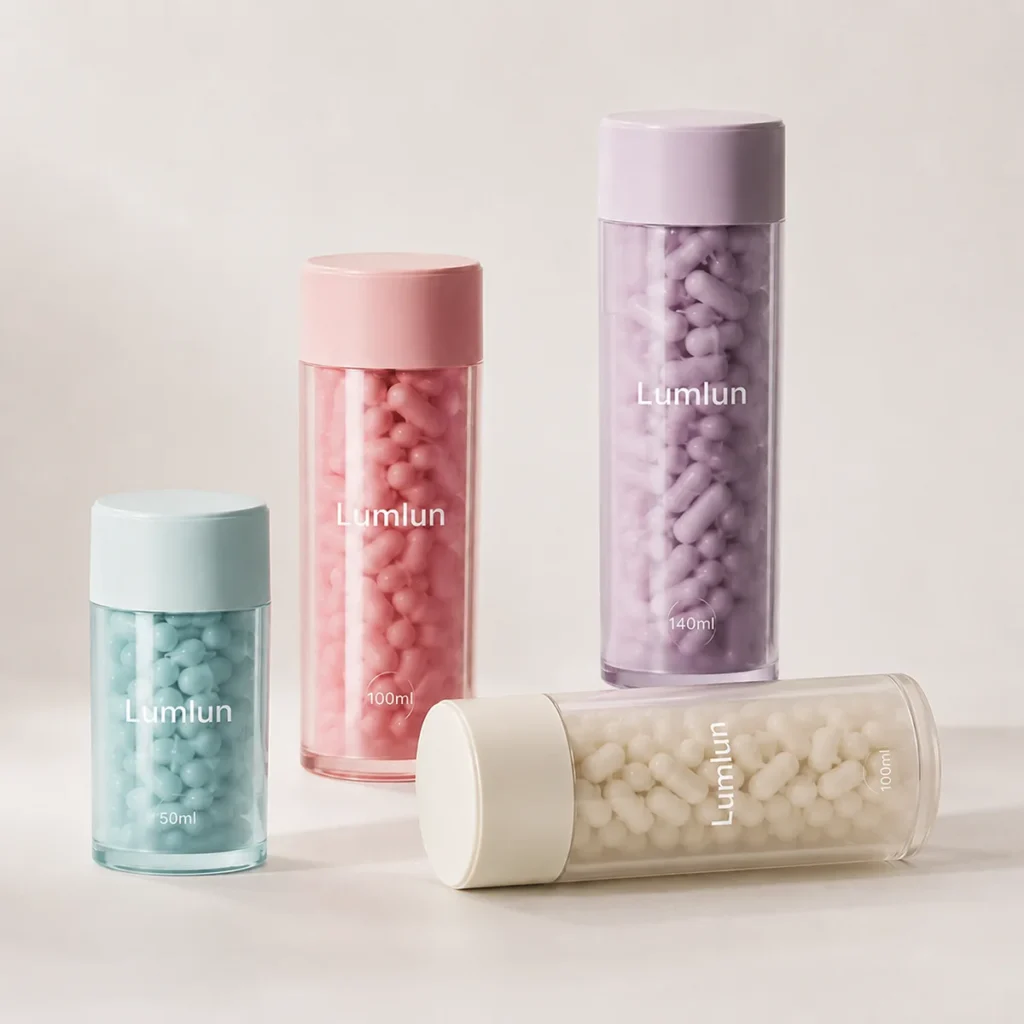
ABS+AS Supplement Bottles for Capsules — 50ml, 100ml & 140ml
A multi-capacity direction for comparing different capsule sizes and counts within one bottle family.
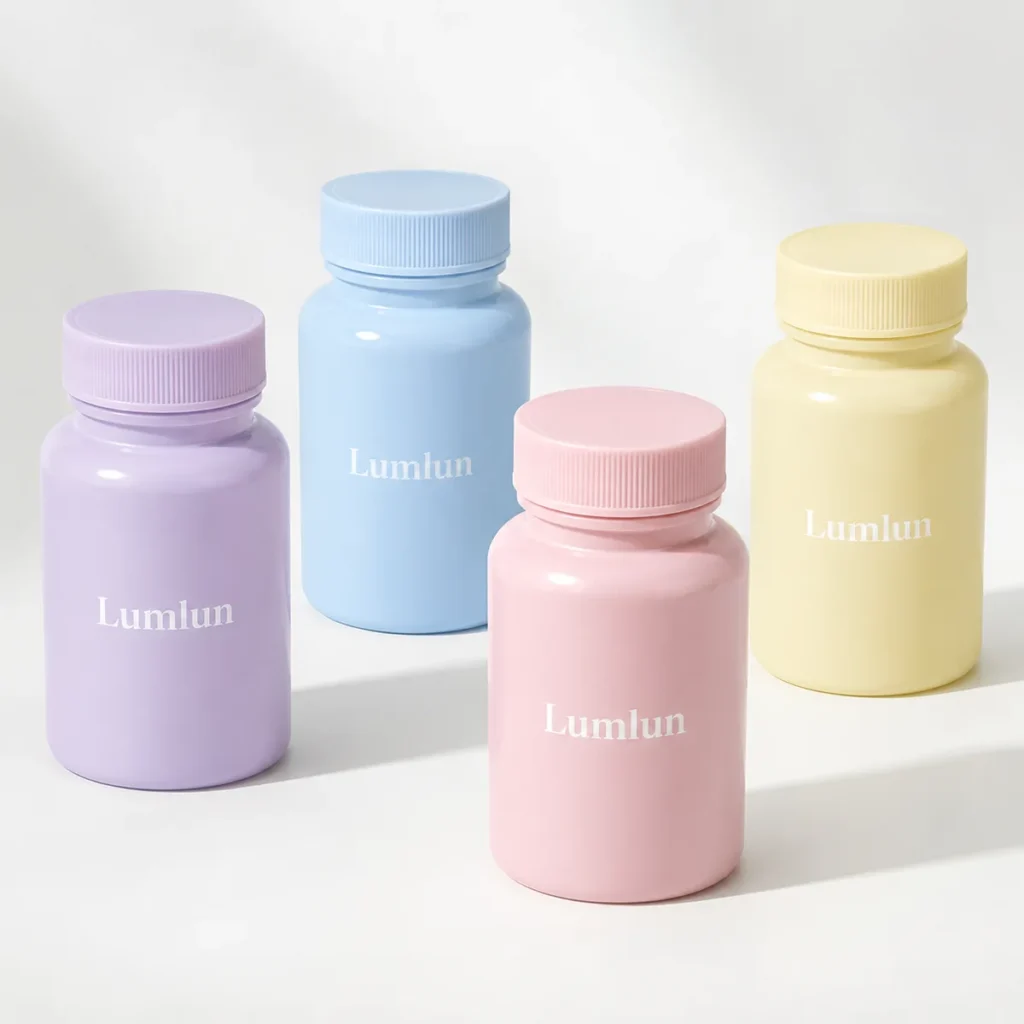
HDPE Capsule & Supplement Bottle — 80ml
A compact 80ml HDPE direction with a ribbed screw cap for projects that fit this model.
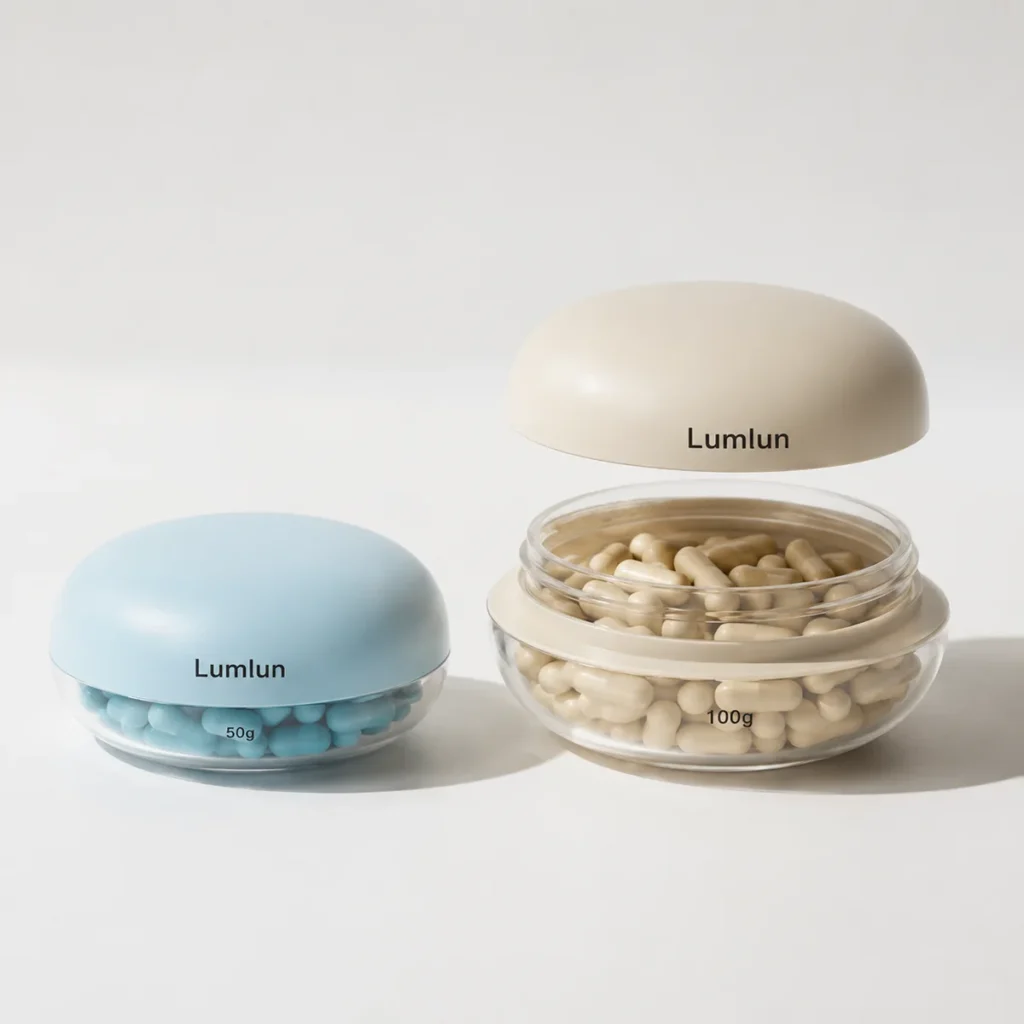
Oval PET Capsule Bottle — 50ml & 100ml
An oval PET direction showing why bottle shape and proportion matter alongside nominal capacity.
Even two 100ml bottles should not be compared by “100ml” alone
Suppose two candidate bottles are both listed as 100ml. That does not make them equivalent. The overall body proportion, shoulder and body space, neck, cap structure, external height and diameter, and available label or artwork area can all differ.
One 100ml bottle may be taller and narrower; another may be shorter and wider. The same group of capsules can settle differently inside those two geometries, and the finished package can look different even though the nominal capacity is the same.
The external shape also changes the usable branding area for the product name, required information and artwork. So the more useful comparison is 100ml Model A vs 100ml Model B, not simply 100ml vs 100ml.
mL helps create the shortlist; the real bottle model determines the final package.
What if the product line later expands from 60 to 90 or 120 capsules?
Do not assume that a 50% increase in capsule count means bottle capacity should be increased by the same percentage. A real bottle family often changes height, diameter, shoulder proportion or overall silhouette as capacity changes.
If a supplement range will include 60-, 90- and 120-capsule versions, the useful question is whether a family of real bottle models can support those different counts while keeping a sensible relationship across the line.
A 50ml / 100ml / 140ml bottle family, for example, can provide several real capacity points to compare. But each final choice still comes back to the capsule size and target count of that specific SKU.

If all you know today is “60 capsules,” what information is still missing?
If the project has only established “60 capsules,” there is no need to lock 50ml, 80ml or 100ml yet. The most useful next piece of information is the actual capsule size.
With capsule size and a target count of 60, several real bottle models can be compared for internal space and overall proportion. If actual capsule samples already exist, those samples provide more packaging information than the words “60 capsules” alone.
The question then changes from “What mL bottle is used for 60 capsules?” to “Which real bottle models make sense for these 60 actual capsules?” The second question is much closer to a real packaging decision.
Choose the contents first, then the container
Supplement bottle sizing can be reduced to one practical principle: look at the capsules first, then the bottle.
Capsule size tells you how large each piece is. Target count tells you how many pieces the bottle must hold. Settling behavior, usable internal space and headspace determine how that group fits in a real container. If the complete pack also uses a desiccant, cotton/filler or another internal component, include the space it occupies as well.
Finally, the actual bottle model determines capacity, shape, neck, cap, label area and the proportions of the finished package.
Instead of asking only “How many capsules fit in 100ml?”, ask “My capsules are this size and each bottle needs this count—what real supplement bottle models should I compare first?”
That turns 50ml, 80ml, 100ml and 140ml from isolated capacity figures into packaging options connected to the actual product. Browse LumLun Capsule & Supplement Bottles to continue comparing real materials, capacities and bottle proportions.