When a fine mist sprayer is not working, the fastest assumption is often that the pump is defective. That is only one possibility. A new sprayer may still be priming; a previously stable sample may have residue near the nozzle; a narrow stream can come from the spray path, actuation, liquid supply or the way the finished formula behaves in that sprayer.
The useful first question is therefore not “Which part is broken?” but “What exactly happens when the sprayer is pressed, and when did that behavior begin?” Once the symptom is clear, the likely causes become much easier to narrow down.
If you are still choosing the package rather than diagnosing a filled sample, use our Fine Mist Spray Bottle selection guide. Diagnosis begins when the bottle or sample already exists and the spray result is wrong or has changed.

Quick Diagnosis: What Happens When You Press the Sprayer?
| What you see | Check first | Do not conclude yet |
|---|---|---|
| No spray at all | Priming, liquid supply, dip tube, visible blockage, assembly | That the pump is defective |
| A narrow stream instead of mist | Nozzle condition, full actuation, formula behavior, liquid supply | That the nozzle alone is the cause |
| Large droplets or a wet center | Partial restriction, formula behavior, spray path | That the whole model is unsuitable |
| Intermittent or sputtering spray | Air in the liquid path, dip tube, fill level, priming | That one irregular press proves a production issue |
| Good at first, worse after storage | Residue, formula change, restart behavior, compatibility over time | That day-one performance tells the whole story |
This table is a starting point, not a fault code. The same symptom can have more than one cause, which is why comparison is more reliable than guessing.

Why May a New Fine Mist Sprayer Not Spray at First?
A new mechanical sprayer may contain air in the pump and dip tube before first use. Full presses draw the liquid into the system until it reaches the nozzle. That initial process is commonly called priming.
For that reason, a few dry first presses do not by themselves prove a defect. There is also no responsible universal rule such as “every fine mist bottle must spray after exactly three presses.” Bottle height, dip-tube length, pump design and the liquid all affect the real result.
The more useful comparison is whether several samples of the same assembled model reach normal operation in a reasonably similar way. If one sample behaves very differently from the others, it deserves a closer look.
What if the sprayer worked before and then stopped?
That is a different diagnostic situation. Check whether enough liquid remains, whether the dip tube is still positioned correctly, whether the actuator returns normally and whether there is visible residue around the outlet. If a second sample of the same model is available, comparing the two often gives more information than immediately taking the sprayer apart.
Why Does the Mist Turn Into a Stream, Large Drops or an Uneven Pattern?
A fine mist sprayer can still dispense liquid while the spray quality has clearly changed. The customer may see a narrow jet, large droplets, a wet center, spray biased to one side or a short burst followed by sputtering. These symptoms are useful because they tell you where to look next, but they do not identify a single cause on their own.

Check the nozzle and spray path
Residue or a partial restriction does not always stop flow completely. Liquid may still pass through while the atomization pattern changes. That can turn a soft mist into larger droplets, an uneven pattern or a narrow stream.
Use a normal full press when comparing samples
A light partial press and a deliberate full press do not create the same operating condition. When you are comparing package performance, keep the actuation as consistent as practical before blaming the hardware.
Do not treat water as the final formula test
A sprayer that atomizes water cleanly can behave differently with the finished toner, facial mist or other product. Viscosity, oils, polymers, suspended material and separation can all change how a liquid moves through the pump and forms droplets at the outlet.
This is not just a packaging rule of thumb. The ASTM D4041/D4041M spray-pattern practice notes that spray patterns can vary with both actuator design and the nature of the liquid. In other words, a reference liquid can help diagnose basic operation, but it cannot prove the final formula will spray the same way.
Check whether the liquid supply is continuous
If the pump draws liquid on one stroke and air on the next, the result may look intermittent or sputtering. Fill level, dip-tube position and assembly therefore belong in the diagnosis together with the nozzle.

Why Can a Sprayer Work Well at First but Get Worse Later?
A sample that looks excellent immediately after filling can behave differently after storage and restart. That is why day-one performance and after-storage performance are two separate observations.
Possible reasons include dried residue near the outlet, suspended material settling, separation within the formula, a change in the way liquid reaches the pump, or an interaction that becomes visible only after the package has been in contact with the formula for some time.
The useful question is not simply “Did it spray once?” It is “Does the complete filled package return to an acceptable, repeatable mist after ordinary storage and use?”
That does not require a full laboratory protocol. A few controlled comparisons at the right time can tell you much more than repeatedly pressing one problem sample.
How Can You Cross-Check the Cause Without Guessing?
Change one variable at a time. If the sprayer, formula and bottle are all changed together, a better result still does not tell you which change mattered.
| Comparison | What it can tell you |
|---|---|
| Problem sample + finished formula | Confirms whether the observed problem can be repeated |
| Fresh sample of the same model + finished formula | Helps separate an individual sample issue from a repeatable formula/package behavior |
| Fresh sample of the same model + reference liquid | Provides a basic operating reference for the sprayer and assembly |
| Several same-model samples + finished formula | Shows whether the same symptom appears across more than one unit |
Reference liquid is a diagnostic aid, not the final approval standard. The finished product still needs to be judged in the actual bottle-and-sprayer configuration intended for production.
What Does the Comparison Result Tell You?
A fresh same-model sample works normally with the finished formula
If the original sample remains abnormal while a fresh sample of the same model works normally, first examine the original unit: nozzle condition, actuator movement, dip-tube position, assembly and individual component condition. One bad sample is not enough to reject the whole sprayer platform.
Several fresh same-model samples show the same symptom with the finished formula
If the same issue repeats with the finished product but the reference liquid behaves normally, the formula–sprayer fit becomes a stronger line of investigation. That is the point to compare another confirmed sprayer configuration rather than keep replacing isolated units.
Samples are normal after filling but several become worse after storage
Shift attention from an individual component to residue, formula condition, restart behavior and longer-term package compatibility.
Only one or two units spray intermittently
Liquid supply, dip-tube position, assembly and priming consistency deserve attention before the complete package direction is changed.
Compare Three Real LumLun Fine Mist Package Directions
Fine mist bottles are not one universal bottle-and-pump combination. The three real LumLun directions below use different capacities and materials. They are shown to make one point clear: troubleshooting should follow the exact assembled model, not the words “fine mist sprayer” alone.
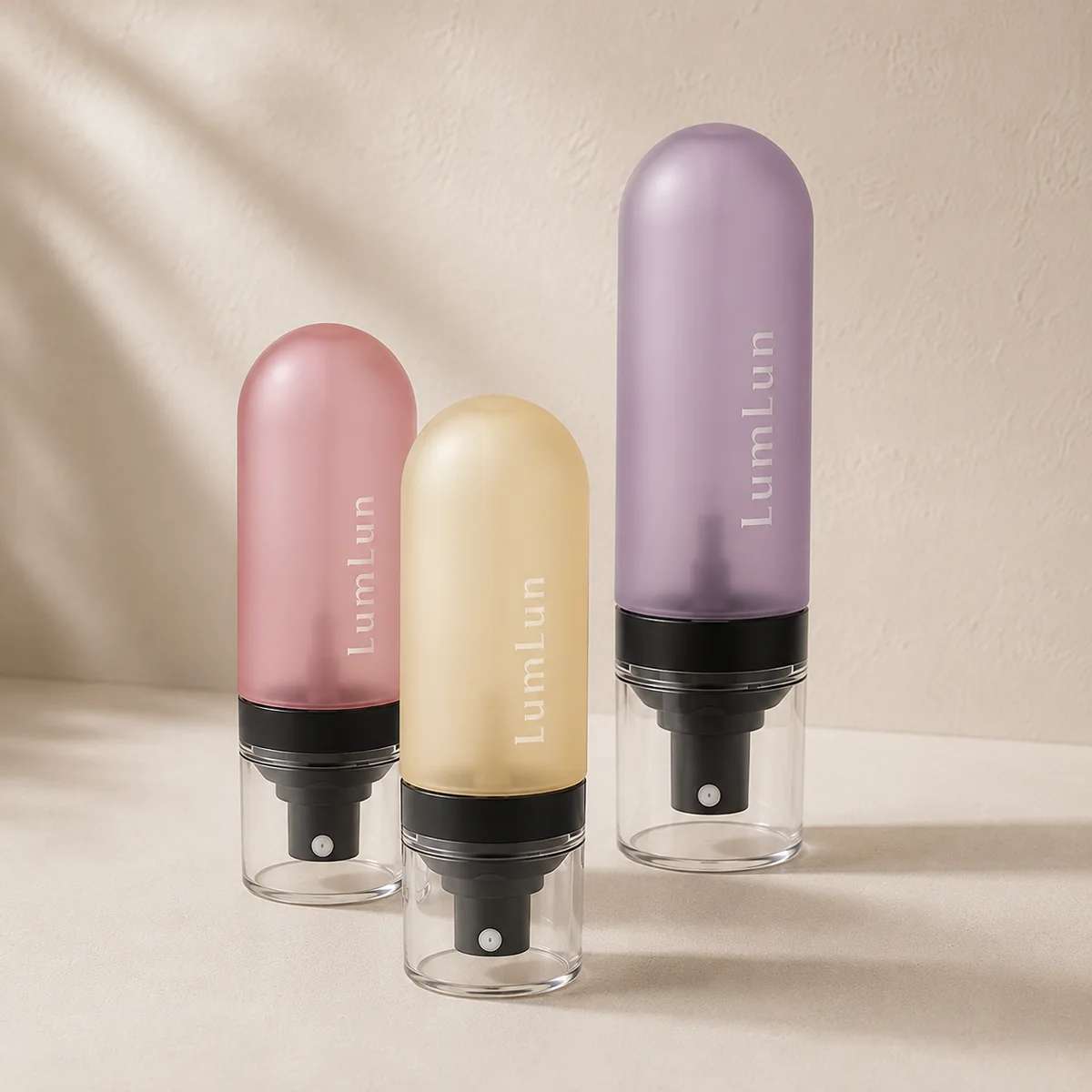


These products are not presented as “fixes” for a spray problem. A different material, capacity or silhouette does not automatically eliminate clogging, streaming or uneven mist. The actual sprayer, bottle, dip tube and finished formula still have to work together.
What Should You Tell Your Packaging Supplier?
You do not need a long technical report before discussing a spray issue. Four pieces of information are usually enough to start:
- the bottle or sprayer model being used;
- the general type of finished formula;
- whether the symptom is no spray, a stream, large droplets, intermittent spray or an uneven pattern;
- whether it appeared from first use or only after use or storage.
A short video can be helpful when available, but it should not be a barrier to starting the conversation. The goal is to decide whether the next step is to inspect an individual sample, compare the same model again, or review the formula–sprayer combination.
Browse all Fine Mist Spray Bottles or contact LumLun if you already have a model in mind.
Already testing a filled fine mist sample?
Frequently Asked Questions
Why does my fine mist sprayer work with water but not my finished formula?
Water can confirm basic operation, but the finished formula may have different viscosity, oils, polymers, suspended material or separation behavior. Those differences can change the spray pattern, so the actual product remains the final reference.
Why does my fine mist sprayer spray a stream instead of mist?
A narrow stream can be associated with nozzle condition, partial restriction, actuation, liquid supply or the way the formula atomizes in that sprayer. Compare the same model under controlled conditions before assigning the cause to one component.
Why does a new fine mist spray bottle need several presses before spraying?
The pump and dip tube may initially contain air and need to draw liquid to the nozzle. The number of priming strokes is model- and liquid-dependent, so there is no universal press count for every fine mist package.
Why does a fine mist sprayer work at first and stop or get worse later?
Look at residue, formula condition, restart behavior, dip-tube supply and compatibility after storage. A sample that worked immediately after filling should not be judged only by that first-day result.
Can a partially clogged nozzle cause large droplets or uneven mist?
Yes. A partial restriction can change the spray pattern without stopping liquid flow completely. That is why large droplets, a wet center or a spray biased to one side are useful symptoms to investigate.
Diagnose the Spray Before Changing the Package
The best troubleshooting sequence is simple: identify the symptom, compare like with like, change one variable at a time, then decide what actually needs to change.
That approach avoids two opposite mistakes: replacing a complete package because one sample was abnormal, or approving a sprayer because it worked once with water. The decision should follow the complete filled package and the behavior the customer will actually experience.