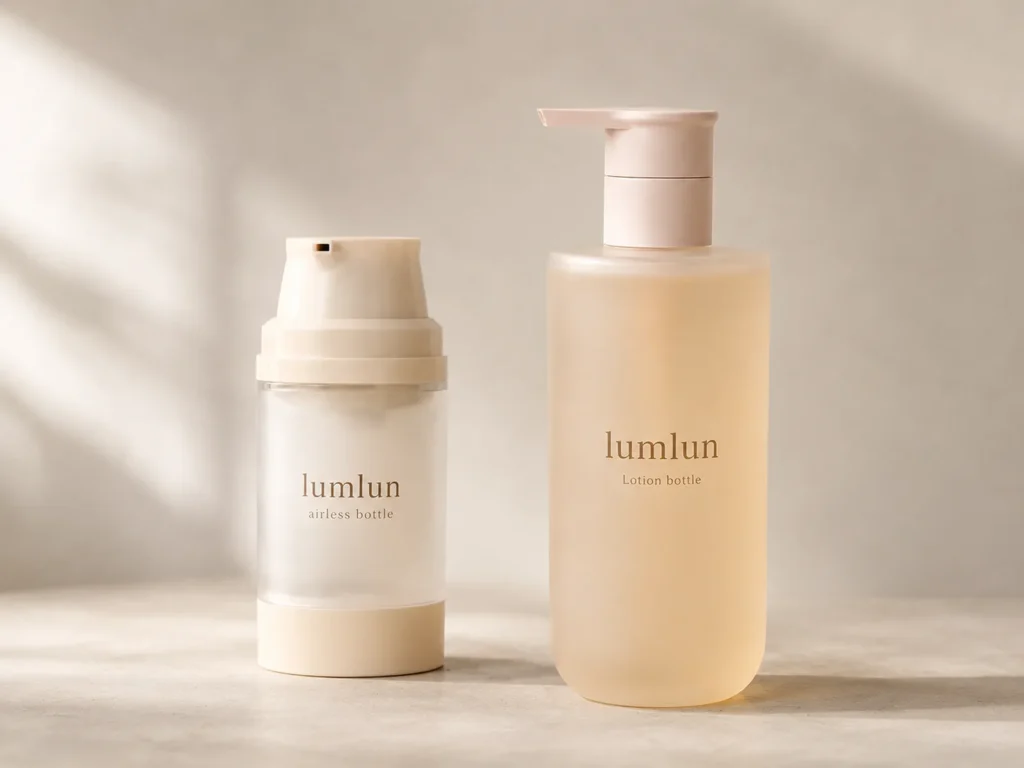
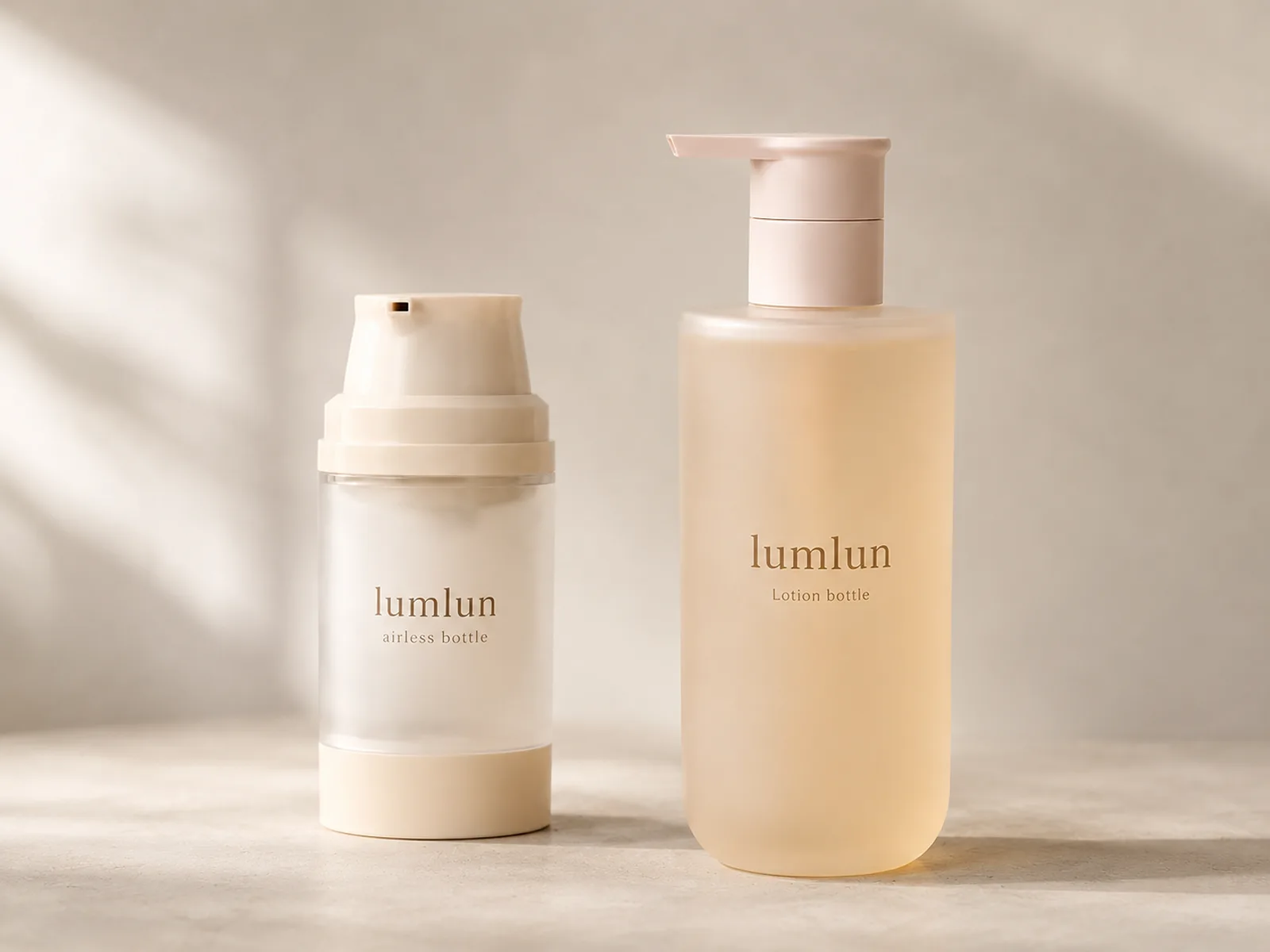
Airless pump bottles and standard lotion pump bottles can both suit skincare, but they usually support different product experiences. The distinction customers notice is not only technical; it is also the scale of the bottle, the style of the dispenser and whether the pack feels like a focused treatment or an everyday routine product.
A useful comparison starts with the product category, expected capacity and way customers will press and use the pack. From there, the bottle, pump, cap and finish can be evaluated as one design rather than treating the dispensing system as a separate component.
Compare the available airless bottle models and lotion bottle models before adapting the artwork. The dedicated guide to lotion pump bottles for body care goes deeper into existing-model selection.
Reviewed by the LumLun Packaging project team · Updated July 2026
Key Takeaways
- Start with the product and daily routine. The best pump format depends on capacity, dispensing style and how customers will use it.
- Treat the dispenser as part of the design. Pump height, nozzle length, collar and cap should feel balanced with the bottle.
- Airless and lotion pumps support different impressions. One may feel treatment-led, while the other may feel familiar and suited to everyday body care.
- Keep the product line visually connected. Different pump systems can still share color, logo and finish.
- Confirm formula fit on the selected model. Dispensing performance is specific to the formula, pump and bottle combination.
Decision Table
Airless pump vs lotion pump: the practical difference
| Decision area | Airless pump bottle | Standard lotion pump bottle | What to review |
|---|---|---|---|
| Dispensing structure | Piston-driven airless system without a conventional dip tube | Pump with dip tube drawing product from the bottle | Selected mechanism, output and actual formula |
| Common product role | Serum, treatment, facial lotion, compact or premium skincare direction | Body lotion, cleanser, hand wash, hair/body care and larger everyday-use direction | Product texture, dose, capacity and routine |
| Visual language | Closed, engineered, layered or treatment-led | Familiar, accessible, daily-use and scalable | Bottle overall shape, pump, collar and artwork |
| Capacity range | Often strongest in compact-to-medium model families | Often available from compact to large body-care sizes | Actual model family and range plan |
Which Pump Format Fits the Product You Want to Sell?
Start with the product role and customer routine, not with a hierarchy between mechanisms.
An airless bottle often fits products that are presented as concentrated treatments, facial moisturizers, serums or controlled-dose skincare. Its closed body and integrated pump can make the package feel compact and engineered. Many airless families also create a clean uninterrupted front panel, which suits a treatment-led visual system.
A standard lotion pump is familiar and easy to understand. It can support facial lotion, body lotion, cleanser, hand wash and other daily-use products, especially when the project needs 150ml, 250ml, 300ml, 500ml or larger formats. The pump action can still feel premium when the pump head, collar and bottle are well proportioned.
The format should make the product easier to sell and use, not more complicated. If a standard pump already gives the desired dose, scale and visual direction, an airless structure is not required simply to make the product look advanced.
What Kind of Brand Image Does Each Pump Format Create?
Airless usually reads as treatment-led and engineered; lotion pump usually reads as familiar, generous and routine-led—but design can shift either impression.
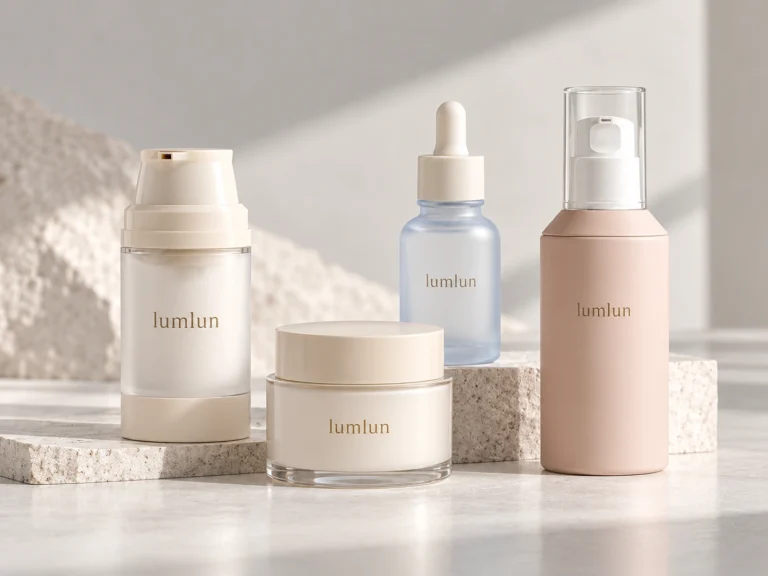
An opaque airless bottle with a top press, twist action or clean pump head can create a modern clinical or premium-treatment look. A clear outer wall can show the piston or inner bottle and add visible structure. Soft matte colors can make the system feel calm and skincare-specific rather than technical.
A lotion pump bottle can look minimal, botanical, clinical, premium or playful depending on the bottle and components. A broad shoulder with a short pump head can feel stable and generous. A tall cylinder with a refined collar can feel elegant. A lockable pump can also become a practical design feature rather than an industrial-looking part.
Avoid assigning fixed meanings to the mechanism. Customers read the complete overall shape, color, typography and context. A strong lotion pump can look more premium than a generic airless bottle, and a well-designed airless system can make a compact treatment easy to recognize.
Which Format Fits Serum, Facial Lotion and Body Care?
Product category gives a starting direction, but texture, dose and capacity decide the real fit.
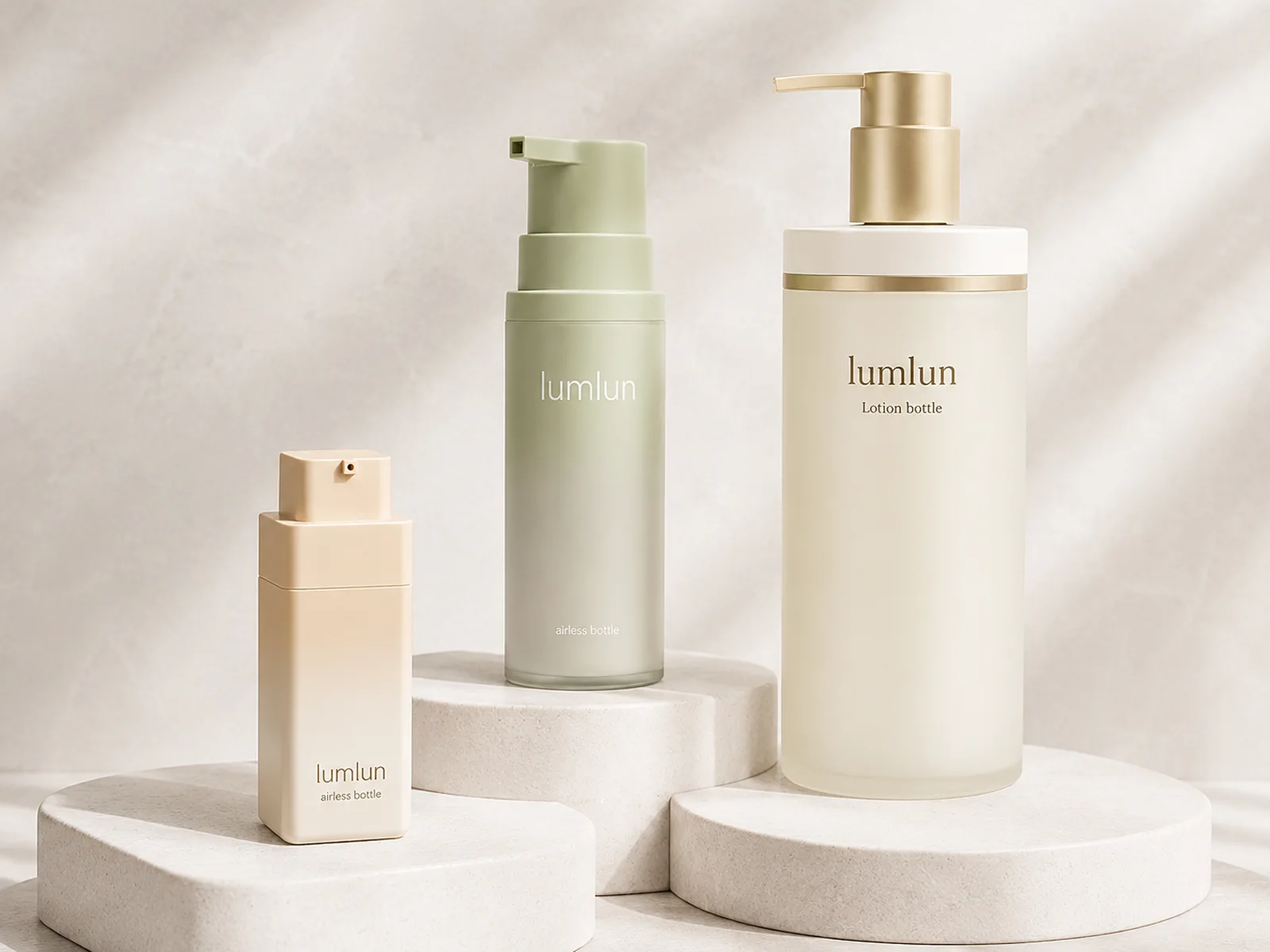
Serums can use airless pumps when the formula and output match, particularly when the brand wants a closed one-handed routine. Flowing serums and oils may also use droppers when formula visibility and measured drops are important. Facial lotions can use either format: airless for a compact treatment direction, or a standard pump for a familiar emulsion or moisturizer routine.
Body-care products often need more volume and a generous pump head. Standard lotion pumps commonly cover the broader size range and can be easier to integrate into body lotion, body wash and hand-care families. Some larger airless models are available and may fit a premium body-serum or sunscreen direction, but the model family and cost need to support the project.
The category name should therefore narrow the shortlist, not close the decision. Share the formula direction and intended capacity so the selected mechanism can be reviewed against a real use case.
How Does Each Format Fit the Customer’s Daily Routine?
Both formats can support one-handed use, but the press action, remaining-product visibility, cap or lock and dose language are different.
An airless bottle often uses an integrated pump head and rising piston. The customer may see the piston move in a clear wall, or the package may remain opaque. The press can feel clean and controlled, and the brand can instruct one or two pumps once the actual output is confirmed. Cap retention, twist locks and top-press designs change portability and use.
A lotion pump draws product through a dip tube. Customers recognize the action immediately, and the long pump head can be comfortable for frequent body-care use. Lockable pumps can help with storage and transport. The bottle may show the remaining product when transparent, or hide it when opaque. The actual evacuation and residue depend on formula, bottle geometry, dip tube and use—not only on the category label.
The best routine is the one that feels natural for the product. A full-body lotion may benefit from a generous pump and stable bottle. A compact facial treatment may benefit from a smaller controlled pump head.
Which Capacity and Bottle Proportion Fit Each Format?
Airless and lotion pump families overlap, but they are strongest in different capacity and proportion ranges.
Airless bottles are often selected in smaller treatment and facial-care capacities, though larger body-care models also exist. The piston, inner bottle and pump head create a specific wall and base structure, so a nominal 50ml or 100ml airless bottle may look more substantial than a simple single-wall bottle. The complete dimensions matter for gift sets and online scale.
Lotion pump bottles commonly cover a wider ladder from compact formats to 250ml, 300ml, 500ml and larger. Tall cylinders, wide round bodies and square bottles create different shelf and countertop behavior. The pump should be scaled to the bottle: a compact pump head on a large body can look weak, while an oversized pump head can dominate a small pack.
For detailed capacity planning, use the guide to 100ml, 250ml and 500ml lotion bottle sizes. Use capacity here only after the pump format has been narrowed down.
How Should the Bottle, Pump and Cap Work as One Design?
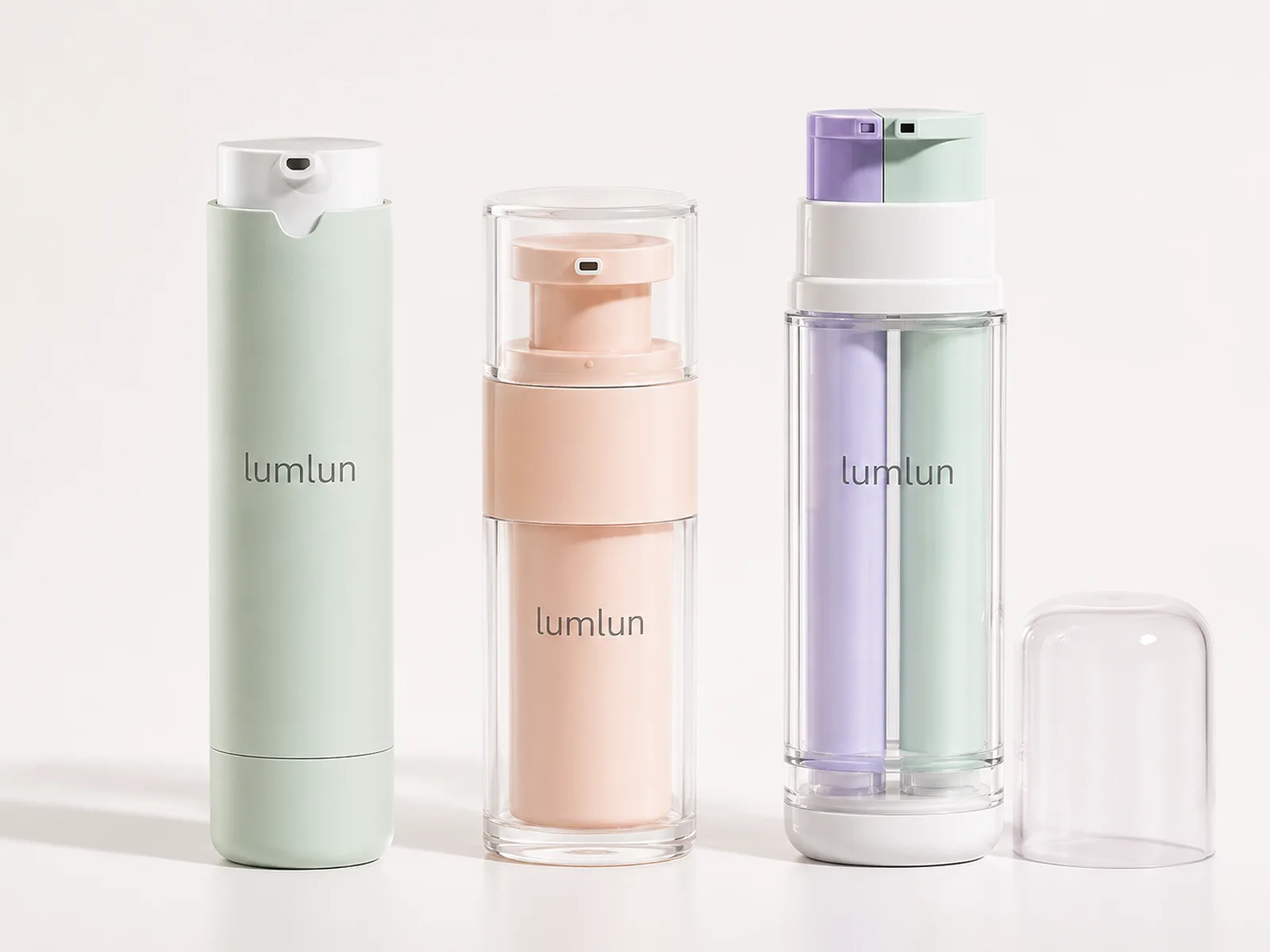
The dispenser is the top of the overall shape, so pump shape, collar, cap and bottle shoulder should be reviewed together.
On an airless bottle, the pump head can sit under a clear cap, inside a twist-up top or within a top-press structure. The visible inner bottle, outer shell and base can create multiple color zones. These zones should be used deliberately rather than allowing the mechanism to look like unrelated components.
On a lotion pump bottle, pump head length, collar height, ribbing, lock and dip-tube bottle neck influence the visual result. A metallic-effect collar can connect the pump to the logo or secondary box. A color-matched pump head can make the overall shape quieter. A black pump can create contrast but should match the product position and the rest of the line.
The practical design rule is simple: review the assembled package from front, side and top. A pump chosen only from a component photo may look very different when placed on the actual bottle.
Which Colors and Finishes Fit the Brand Position?
Use finish to clarify the product role, not to hide a weak structure or add decoration without a reason.
Airless bottles can use opaque Pantone colors, gradients, frosted or clear outer walls, matte or glossy effects, silk-screen printing, hot stamping and metallized component details depending on the model. The layered structure can create opportunities for a colored inner bottle and a transparent shell.
Lotion pump bottles can use similar decoration directions across PET, PE, glass and other model-specific materials. A matte body with a color-matched pump can feel soft and modern. A clear or frosted body with a metallic collar can feel more decorative. The finish must be evaluated on the selected surface and with the planned filling and handling conditions.
Compare the available LumLun customization and sustainability options after the pump format and bottle family have been selected.
How Does the Choice Affect Future Product-Line Expansion?
The strongest format is the one that can support the next SKUs the brand actually plans to launch.
An airless family may extend from eye treatment to serum, facial lotion and cream-pump formats, creating a treatment-led line. A lotion pump family may extend from facial lotion to body lotion, cleanser, hand wash and hair/body care, creating a broader daily-use system. The available capacities and related shapes depend on the real catalog family.
A brand can also use both formats when the roles are clear. Airless can carry the concentrated treatment range while lotion pumps carry larger body-care products. Shared color, logo position, cap or collar tone and typography can keep the line connected.
Do not force one mechanism across every product simply for uniformity. Functional fit and customer routine should come first; visual consistency can be created through the design system.
Can an Existing Pump Bottle Match Your Reference Design?
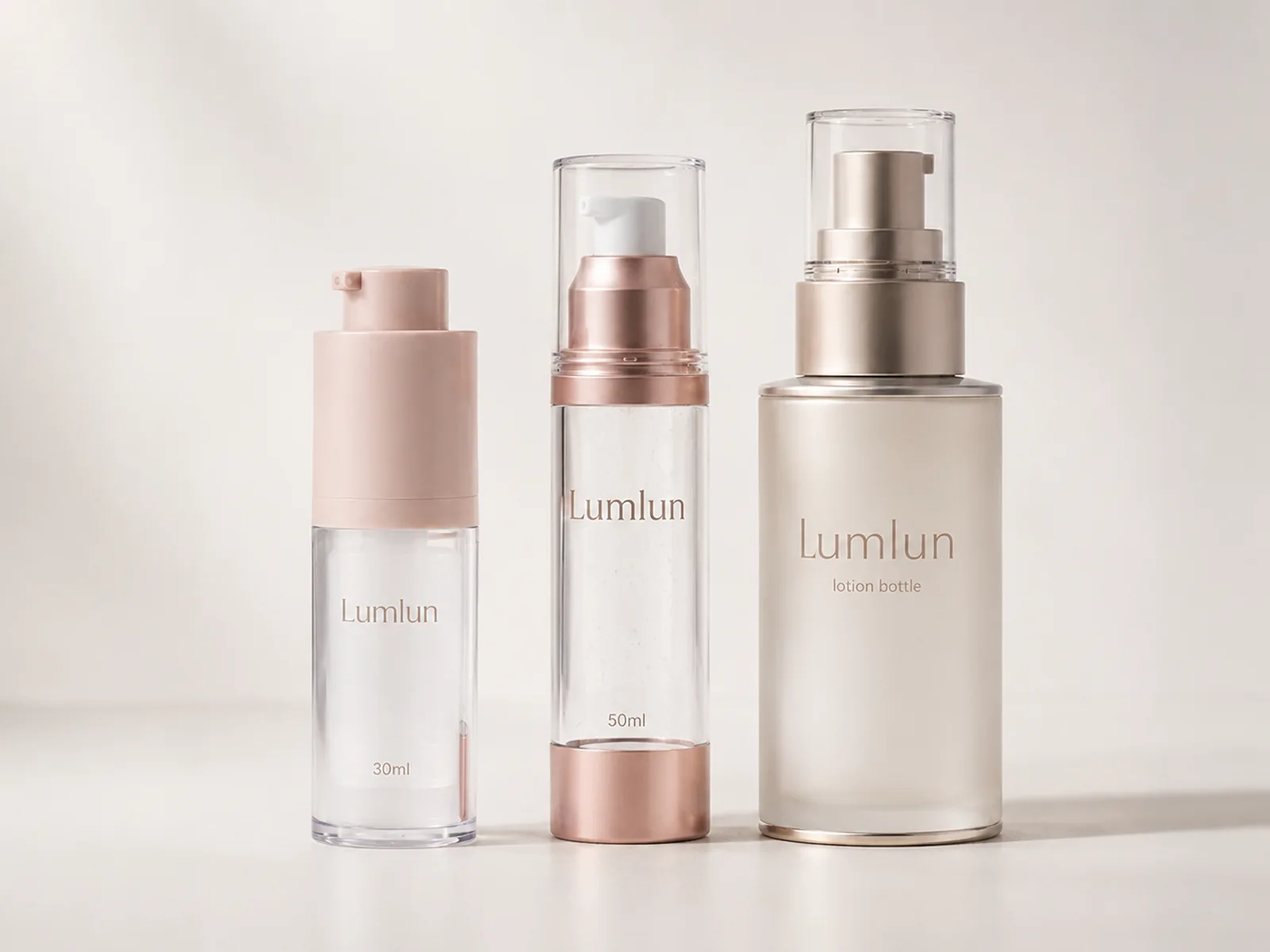
A reference image can be translated into a shortlist by separating the bottle shape, pump head, cap, capacity and finish.
Many references combine a standard bottle overall shape with a custom color or decorative collar. An existing model may reproduce the visual direction closely without reproducing every dimension. Another reference may depend on a proprietary top-press or twist structure that cannot be created through decoration alone.
LumLun can compare the image with real airless and lotion pump models, identify what is structurally similar and explain what can be changed through Pantone color, printing and finishing. If the exact mechanism or overall shape is essential and no model is close enough, tooling can be evaluated as a separate route.
This approach keeps the project honest. The goal is not to promise an exact copy from one image; it is to find the most realistic way to deliver the intended brand experience.
Airless Pump or Lotion Pump: How to Make the Final Decision
Choose airless for a closed treatment-led format when the model fits the formula and capacity; choose a lotion pump for familiar everyday dispensing and broader larger-size flexibility.
First, define the product and routine. A compact serum or facial lotion that benefits from an integrated press may point to airless. A body lotion, cleanser or hand wash that needs a generous pump head and a larger bottle family may point to a standard pump. Next, compare the complete bottle proportions and available decoration.
Then compare the total project. Airless may add component and assembly complexity but can create a differentiated treatment package. A standard lotion pump may provide the necessary experience with a simpler structure and more capacity options. Neither cost nor mechanism should be judged in isolation.
Finally, shortlist actual models and confirm the selected direction with the brand’s formula, filling process and market requirements. The best choice is the one that supports the product without creating complexity the customer does not value.
Decision Table
Which pump format fits the product?
| Project direction | Stronger starting format | Reason | Related alternative |
|---|---|---|---|
| Compact treatment serum or facial lotion | Airless pump | Closed appearance and piston-driven dispensing support a treatment routine | Dropper when visible formula and measured drops are central |
| Daily body lotion or cleanser | Lotion pump | Familiar one-handed use and broader larger-capacity families | Tube when portability and squeeze dispensing matter |
| Rich cream in a premium format | Model-specific airless bottle or airless jar | Some suitable airless systems can support richer formulas | Cream jar or tube if the texture or use action fits better |
| Large family or professional pack | Lotion pump | Standard pump families commonly support larger capacities | Refill pack plus reusable bottle when the brand has a real refill system |
Final Recommendation
Use an airless pump bottle when the product needs a closed, treatment-led format and the selected model suits the formula, dose and capacity. Use a standard lotion pump when familiar one-handed dispensing, larger body-care sizes and a broad product family are the stronger priorities. Do not pay for a mechanism that the product story does not need.
Frequently Asked Questions
What is the difference between an airless pump and a lotion pump?
An airless bottle uses an airless dispensing system and internal package architecture, while a standard lotion pump draws product through a dip tube from the bottle. They create different capacity and use directions.
Is an airless pump necessary for every skincare product?
No. Many lotions, cleansers and body-care products work well with standard pumps. Airless is useful when its dispensing experience and package direction fit the product.
Which pump format suits facial lotion?
A compact airless bottle often fits facial-lotion positioning, but a standard pump can also work. Formula texture, dose, capacity and desired visual style should guide the choice.
Which pump format suits body lotion?
Standard lotion pumps are common for medium and large body-lotion sizes. Airless formats can be considered for premium or smaller treatment-led body-care products.
Can both formats share one visual design system?
Yes. Use consistent color, logo hierarchy, finish and component accents so different dispensing systems still look like one brand family.
PUMP BOTTLE OPTIONS
Compare Airless and Lotion Pump Bottle Options
Browse LumLun pump packaging or send one reference image. We can begin with the product type and approximate capacity, then narrow the closest options.