When a Dual-Chamber Airless Bottle Fits a Two-Product Skincare Project
A dual-chamber airless bottle is a package with two separate product chambers inside one coordinated bottle format. Depending on the model, the two sides may have separate pump heads or another designed dispensing arrangement.
“Dual chamber” describes the two-product structure. It does not tell you by itself whether both formulas dispense together, separately, in the same amount or through the same type of outlet. Those details belong to the exact model.
It makes the most sense when the two products are intentionally connected. Common examples are a Step 1 + Step 2 routine, two products used at different times, or two formulas that should stay in separate chambers but be sold as one coordinated package.
| Two-product relationship | When dual chamber fits well | When two separate packs may be clearer |
|---|---|---|
| Step 1 + Step 2 | Both products are normally used in sequence and are purchased as one routine. | One step is optional, much larger or replaced much more often. |
| AM + PM / selective use | The user chooses one side according to time or use case. | Each product is frequently carried, sold or replaced on its own. |
| Designed combination | Both sides are intended to be used in one application and a confirmed mechanism supports that action. | No existing model supports the required output or ratio. |
The strongest fit is a pair that is easy to explain as one purchase: day/night, two treatment steps, serum + supporting product, or another pair that is normally used in the same routine. The two formulas do not need to be chemically linked; they need a clear reason to share one package.
If buyers would normally choose one product without the other, or if the two products belong to unrelated categories, separate bottles may be easier. The package should reflect an existing product relationship rather than invent one.
Day/night is easy to understand when each side is clearly identified and the capacities reflect the planned use. Two independent pumps can make the roles obvious because each product is selected directly.
The same idea can work with another architecture, but the labels and actuation should make it immediately clear which side is being used. This is a packaging clarity question, not a claim that day/night products need dual chamber.
Different product types can share one pack when the selected outlets suit both formulas. Potentially, but only when each side has a dispensing path that can handle its formula. A low-viscosity serum and a more viscous cream may need different pump outputs or internal paths.
This is why formula pairing should be checked against the actual two sides instead of being described broadly as “works with serum and cream.” Two chambers separate products; they do not remove pump-formula compatibility.
The product relationship comes before the bottle. Decide this before choosing the pump. If the products are separate steps, independent controls are usually easier to understand. If both formulas must be released together, the actuator and output relationship have to be part of the confirmed bottle design.
This is also why a dual-chamber bottle should not be selected from the outer shape alone. Two bottles can look similar while using different internal chambers, pumps and outlet paths.
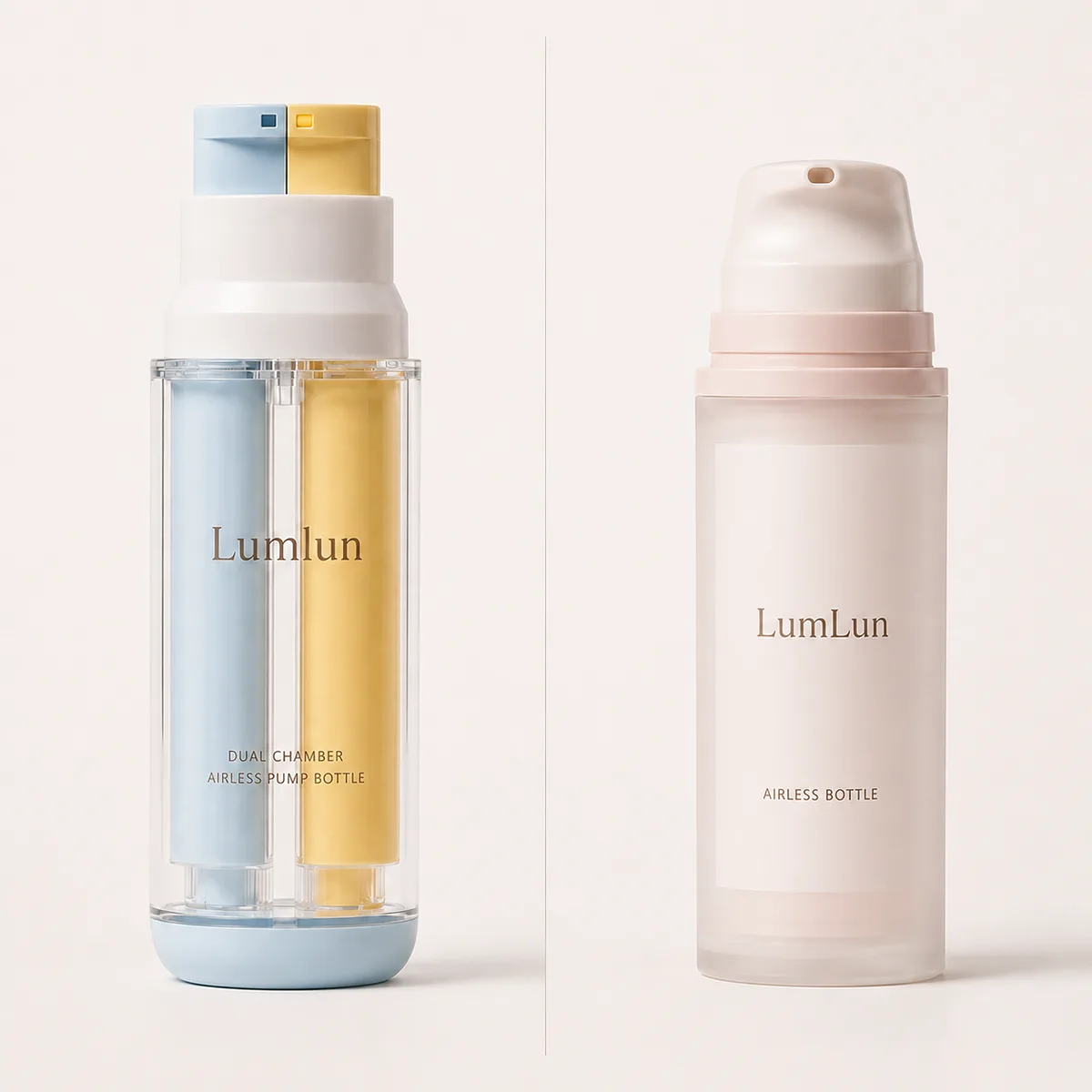
Dispensing behavior depends on the selected model. No. Dual chamber is not one universal dispensing mechanism. Some systems use independent pumps; some specially designed systems use one actuator and a defined output relationship. The bottle must be selected from the action the product needs.
Do not assume a fixed mixing ratio or simultaneous release unless that function is confirmed for the exact model. This protects the product brief from being built around a mechanism the selected package does not have.
Dual chamber confirms two separate product reservoirs. Any mixing function depends on the exact pump architecture and should only be described when the selected model supports it. Whether they are released separately, together at the outlet or in a designed ratio depends on the actual pump architecture.
If fresh mixing is a product requirement, state that as a separate functional need and confirm a model that is designed for it. A standard two-chamber bottle should not be marketed as a mixing system without evidence.
Dual chamber is not the same as a dual-phase formula. Not necessarily. “Dual phase” can describe a formula with two phases inside one product, while dual chamber describes two separate packaging reservoirs. Those are different decisions.
For dual-chamber packaging, the relevant structure is two separate product roles in two chambers. If one finished formula contains two phases in the same reservoir, it should be evaluated as one product and one compatible dispensing system.
Choose the Dispensing Structure for the Two Products
Twin pumps suit products that need independent control. The user can select Side A, Side B or both in the required sequence. A shared actuator is relevant only when the two products are always meant to dispense together and the model has a confirmed designed ratio or output relationship.
For sourcing, treat these as different complete architectures. A pump head is not a decorative part that can automatically be moved from one dual-chamber body to another.
A twin-pump design makes the two sides visibly independent. The user can normally identify which actuator belongs to which product, and each pump can be evaluated with its own formula.
The tradeoff is a wider or more detailed top layout compared with a single actuator. Use the actual model dimensions and sample to judge whether that layout fits the intended product.
A shared actuator can simplify the visible top, but it also makes the relationship between the two outputs part of the mechanism. The buyer should confirm whether the two products are released together and how the dose from each side is controlled.
Do not assume a shared actuator is automatically simpler for filling or formulation. It is simply a different dispensing architecture.
A spray + lotion combination can be a real dual-chamber direction, but the two dispenser types must be confirmed as part of the same model. The formula path, pump connection and top assembly are different from a standard twin-lotion-pump layout.
If one side needs a mist spray and the other a lotion dose, state those two dispensing actions early. Then the closest existing structure can be checked before artwork or decoration is developed.
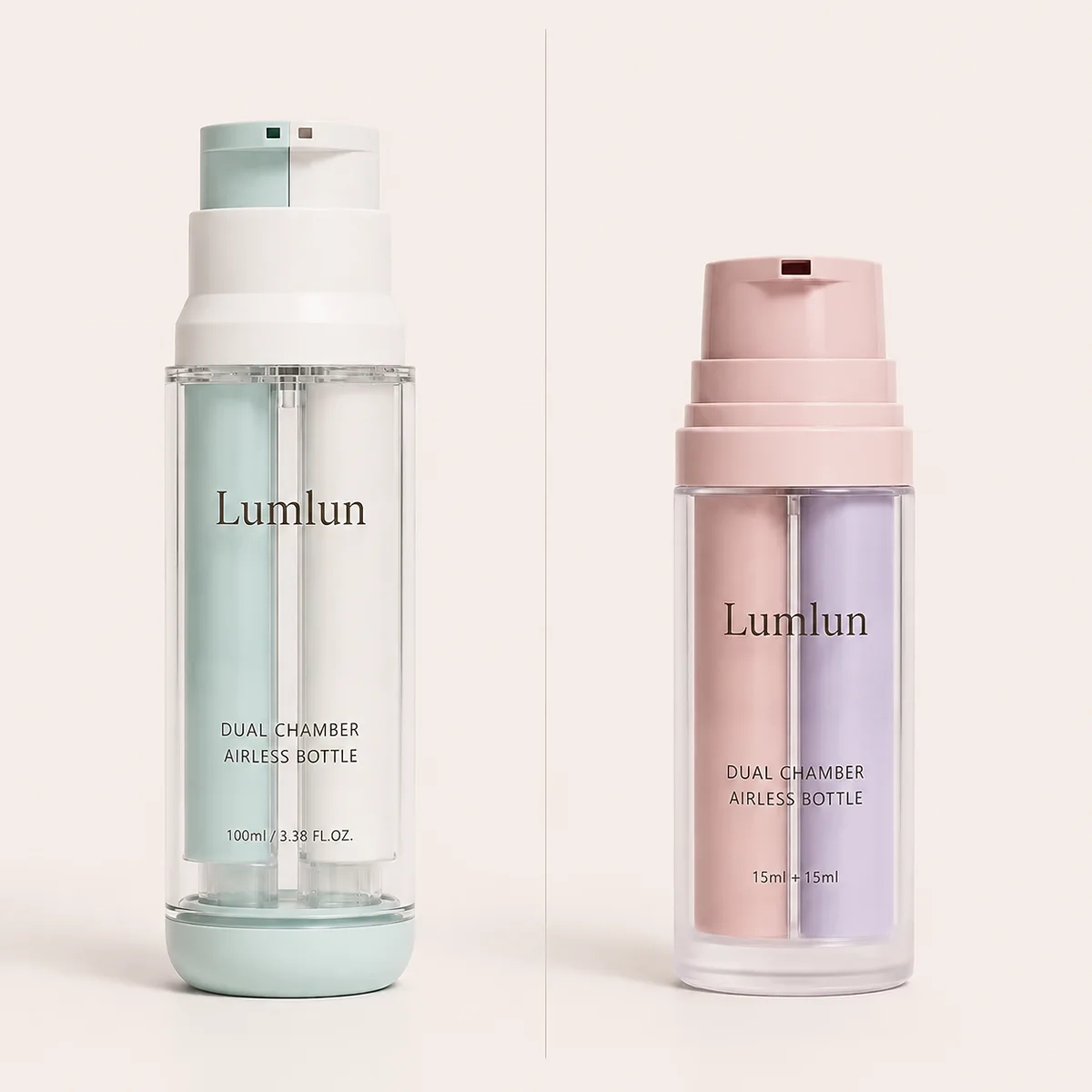
They can be considered when each side has a dispensing path that works with its own formula. A fluid serum and a lotion do not automatically need the same pump or outlet, so the exact architecture matters more than the fact that both formulas fit inside the outer bottle.
At the first comparison stage, identify whether both products are fluid, lotion-like, cream-like or sprayable. That is usually enough to rule out an obviously mismatched outlet before a filled sample is prepared.
The airless structure is one part of the package, not a universal stability guarantee. The result still depends on the exact inner chambers, pumps, seals, materials, formula and filling conditions. Avoid turning the word “airless” into a fixed shelf-life or compatibility claim.
What dual chamber reliably provides is the ability to keep the two product reservoirs separate inside one package. The actual protection and dispensing performance should be confirmed on the selected complete model.
Match Chamber Capacity, Material and Bottle Size
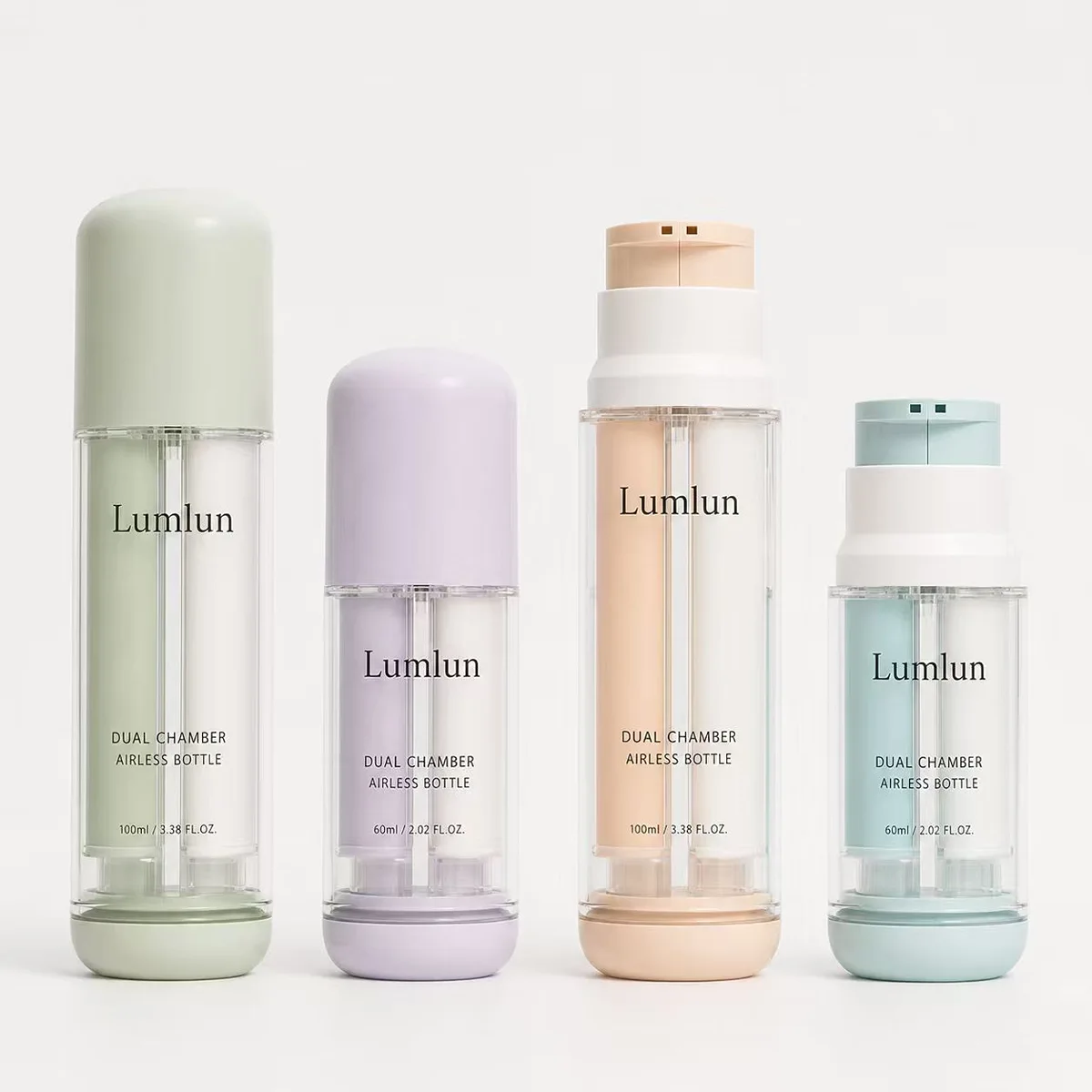
LumLun has several real dual-chamber model families. The capacity wording matters: 2×10ml and 2×15ml explicitly describe two equal chambers, while a listed total size such as 60ml or 100ml should not be assumed to mean an equal internal split unless the model record confirms it.
| LumLun model | Confirmed capacity | Confirmed material | Useful when |
|---|---|---|---|
| Dual-Chamber Airless Bottle — 2×10ml or 2×15ml | 2×10ml / 2×15ml | PETG | A compact paired format with two product roles. |
| Clear PETG Dual-Chamber Airless Bottle — 60ml & 100ml | 60ml / 100ml | AS + PP + PETG | A larger clear dual-chamber direction; confirm the exact chamber allocation. |
| Dual-Chamber Lotion Bottle — 2×15ml or 2×30ml | 2×15ml / 2×30ml | ABS + PP + AS + PETG | A wider lotion-bottle proportion with equal paired capacity. |
| Dual-Chamber Airless Pump Bottle with Twin Pumps — 30ml–100ml | 30ml / 50ml / 100ml | PMMA + PP | A twin-pump family across several listed total sizes. |
Compare how quickly the two products are expected to be used. Equal paired chambers work naturally when both products are used in roughly similar amounts. If one side is used much faster, an unequal chamber model or two separate packages may be a better fit.
You do not need a perfect usage calculation at the first stage. A simple comparison such as “both used once daily” or “Side A is used about twice as much as Side B” is enough to avoid an obvious capacity mismatch.
Chamber sizes are model-specific. No general rule requires equal chamber sizes. Some LumLun models are explicitly listed as 2×10ml, 2×15ml or 2×30ml, while other larger dual-chamber products are listed by total bottle size. The chamber relationship belongs to the selected model.
If the two products are used in very different amounts, look for a structure that reflects that relationship or compare two separate packs. Equal chambers are convenient only when they make sense for the real routine.
That is a strong sign to review the capacity relationship. A combined pack is easiest when both sides have a sensible replacement cycle. If Side A is used twice as fast, equal 15ml + 15ml chambers may not match the real routine.
The answer may be another dual-chamber model, a verified unequal split or two coordinated packages. It is better to solve the capacity relationship before decoration than to explain an awkward replacement cycle later.
Use rate matters when choosing chamber size. Yes, but the replacement logic should still make sense. If one product is used twice daily and the other once a week, equal chamber sizes may create a poor match even though the packaging works mechanically.
Before choosing the bottle, estimate the relative use of the two products. This is usually more useful than choosing chamber size from the total milliliters alone.
Frequency matters for the same reason as capacity. A day cream used every morning and a treatment used twice a week will not empty at the same pace even if both chambers have equal volume.
If the products are intentionally replaced together, the difference may be acceptable. If buyers would regularly discard one side with product remaining, a different chamber split or two separate packs may fit the project better.
Pump output is model-specific. The amount needed from Side A and Side B may be similar or different depending on the products, but the actual output must come from a real pump specification rather than a generic dual-chamber number.
If output per press is central to the project, compare it after the bottle family is selected. The separate Pump Output comparison explains that decision without adding unnecessary pump-engineering detail here.
They can only do so when the selected pump architecture supports it. With two independent pumps, each pump can have its own model-specific output. With a shared actuator, the relationship between the two outputs is part of that model’s design.
Do not design the product ratio first and assume any dual-chamber bottle can reproduce it. Start from the real pump system, then confirm whether its output fits the intended product pair.
The material is model-specific. Current LumLun product records include PETG, AS + PP + PETG, ABS + PP + AS + PETG and PMMA + PP across different dual-chamber families. These are not interchangeable material menus for one bottle.
Choose the structure first, then confirm the material of that exact model. Color, finish and decoration can be reviewed after the bottle family is real.
Do not assume that from the phrase “dual chamber.” The current LumLun families use different material combinations such as PETG, PP, AS, ABS and PMMA depending on the model. The relevant contact and structural materials should be read from the exact product specification.
If a project has a specific material target, use that requirement to filter the existing model list instead of combining parts from unrelated dual-chamber families.
A transparent PETG outer can make the inner construction more visible, but the exact visibility depends on the real inner bottles, wall construction, color and decoration. The product image should be used to judge the selected model rather than assuming every dual-chamber PETG bottle looks the same when filled.
If seeing the two products is important to the concept, compare a physical sample before finalizing color and decoration.
Two chambers and two pump paths can create a wider or more complex outer shape than a single-chamber bottle at a similar nominal volume. Total width, height and top layout therefore matter when the project has carton, display or shelf-space limits.
Use the assembled dimensions of the real model. Comparing only the total milliliters can hide a meaningful difference in footprint.
Compare Dual Chamber With Other Packaging Formats
Use the same comparison fields for both candidates: chamber capacity, pump arrangement, material, assembled size, dispensing action and how the two product roles are identified. This makes the difference between models easy to see without turning the comparison into a long engineering specification.
If one model is closer in capacity and pump architecture, that usually matters more than a small difference in outer shape. Decoration can be developed after the structural fit is clear.
A dual-chamber bottle keeps the two products physically together and can make a paired routine easier to manage as one package. Two separate bottles give more freedom when the products need different capacities, different dispensers or different replacement cycles.
Neither option is automatically better. The simpler choice is the one that matches how the two products are actually sold and used.
Two separate bottles can be better when the products need very different capacities, different replacement timing, different dispensers or independent product formats. A dual-chamber package creates the most value when the two products genuinely belong together.
The goal is not to maximize chamber count. It is to choose the simplest package that makes the two-product relationship easy to use and easy to source.
They can, but the packaging strategy should be clear. If the same formulas are also sold as individual products, keep the dual-chamber pack as a deliberate combined option rather than treating it as the only way to buy them.
This matters for capacity and labeling because the combined pack may use different fill volumes from the individual SKUs. The dual-chamber model should therefore be specified on its own terms.
Dual chamber solves a two-product task; the 3×10ml model solves a different three-formula task. Dual chamber is built around two product roles. LumLun’s current 3×10ml multi-chamber model is a specific three-formula structure with three 10ml chambers and simultaneous dispensing from all three outlets.
If the project needs three equal small product roles rather than two, compare the 3×10ml Multi-Chamber Airless Bottle. Keeping the two tasks separate makes the model choice much clearer.
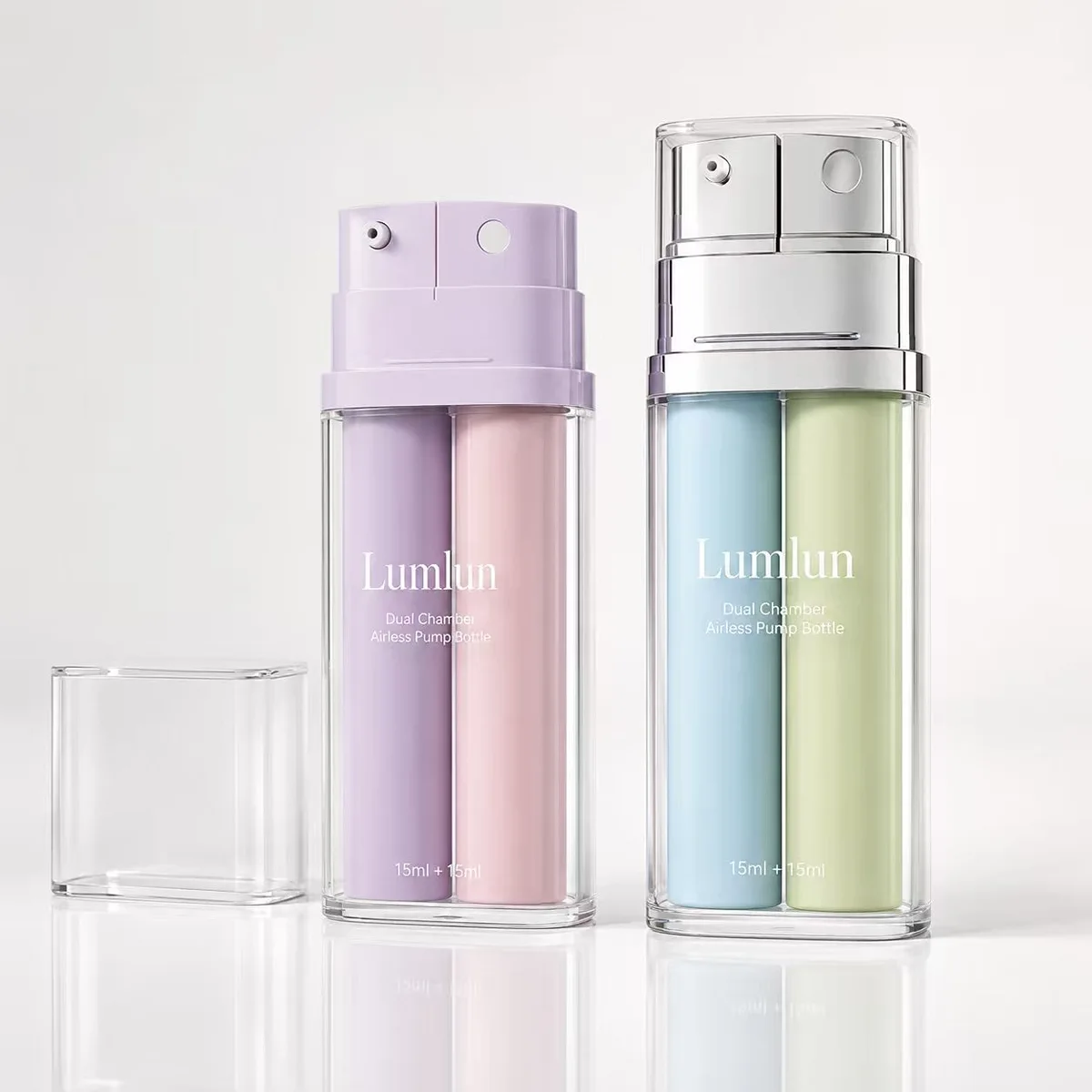
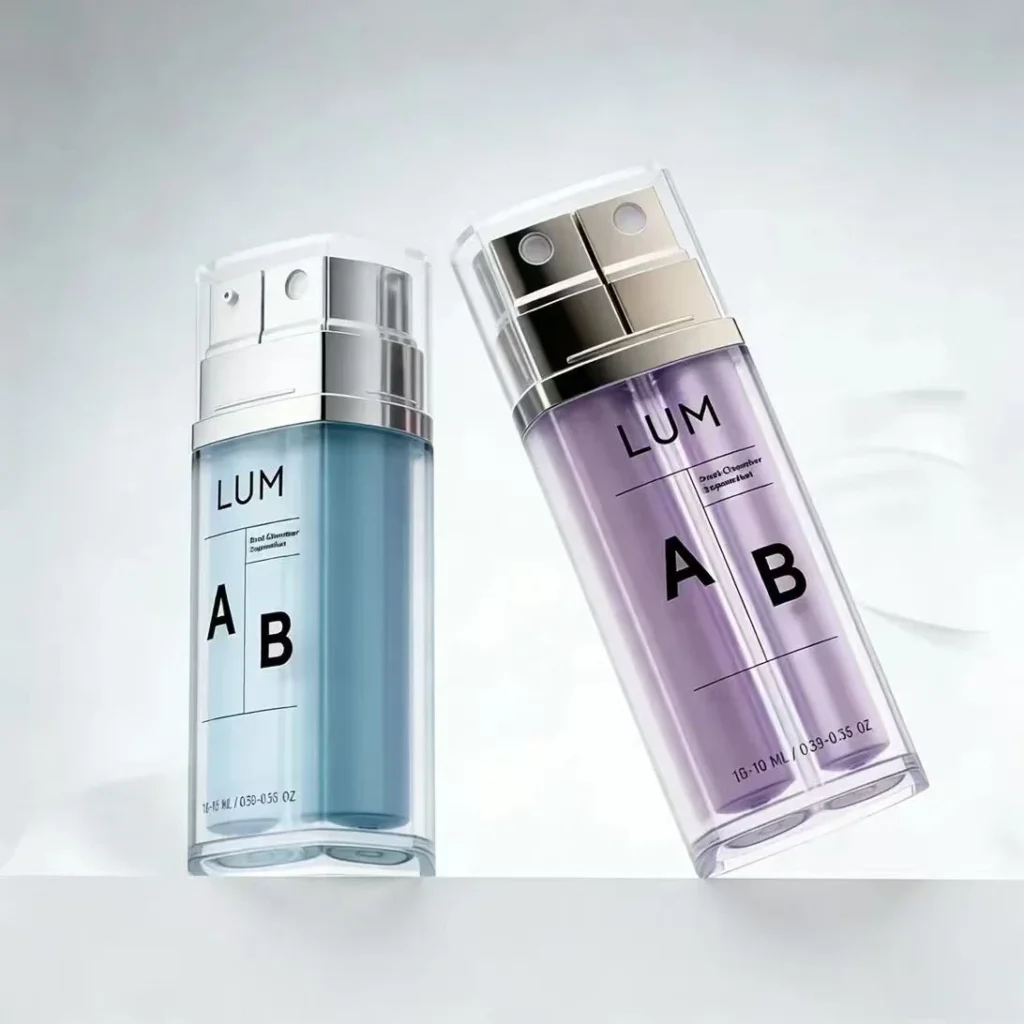
Keep the two product roles clear. If the products have separate pumps, the two sides should be easy to distinguish without adding a long instruction block. Short names such as A/B, AM/PM or Step 1/Step 2 can work when they match the real routine.
Color can support the distinction, but the product names and dispensing action should remain understandable even without relying on color alone. The bottle should still read as one coordinated pack rather than two unrelated labels placed side by side.
They should be identifiable whenever the user can choose one side independently. Short names, Day/Night or A/B are usually clearer than a long explanation around the pump area.
If a shared actuator always dispenses both products together, the front label can focus more on the combined product concept, but the specification still needs to identify what is filled in each chamber.
Within the decoration options supported by the selected model, the two product roles can be distinguished while the outer package still looks like one coordinated design. This is useful for Step 1 / Step 2 or AM / PM concepts.
Keep structural facts separate from decoration. Color and artwork can change; chamber geometry, pumps and outlet positions remain model-specific.
Where the selected model and process allow it, the two product roles can be differentiated through color, printing or labeling. That can make independent use easier to understand.
Decoration should follow the confirmed structure. It should not be used to imply a different pump function or chamber ratio from the one the model actually provides.
Customize and Confirm the Selected Dual-Chamber Model
Yes. A reference image is useful for identifying body shape, chamber layout, visible pump arrangement, capacity direction and overall proportions. LumLun can use those features to look for the nearest existing model.
A photograph cannot confirm hidden details such as the exact chamber split, pump output or internal connection. Those stay tied to the real product record and sample.
A filled sample confirms the product-dependent dispensing points. After the realistic model is selected, a filled sample should answer the few questions that cannot be settled from a drawing: does each side prime, does the formula flow through the intended outlet, is the output usable and does the closure behave normally?
This does not need to become a large testing checklist. A filled sample confirms the product-dependent dispensing points after the model direction is already clear.
An empty sample is useful for size, pump layout, color and general handling. A filled sample is needed for the questions that actually depend on the products: priming, formula flow, dose relationship and whether one side behaves differently from the other.
This two-stage view keeps the process practical. The first sample narrows the structure; the filled sample confirms the final dispensing choice.
Customize the existing model after the structure is selected. Once an existing structure is chosen, projects can normally review the confirmed color, artwork, component matching and suitable decoration for that model. The chamber count, pump architecture, outlet positions and capacity range stay tied to the existing construction.
If another LumLun model already has a closer pump, capacity or material direction, comparing that model is usually more practical than forcing a structural change into the first option.
Refillability should only be claimed when the exact model has a confirmed replaceable or refill structure. Dual chamber and refillable are separate packaging features.
If a project requires both, filter the product search for a model that explicitly supports both functions instead of assuming two chambers can be removed and replaced.
New tooling only becomes relevant when an important structural requirement cannot be met by the available models—for example a specific chamber ratio, actuator arrangement or body shape that is central to the product concept.
Start from the closest existing model first. This keeps the early decision simple and gives the project a real reference for size, material and dispensing before any structural change is considered.
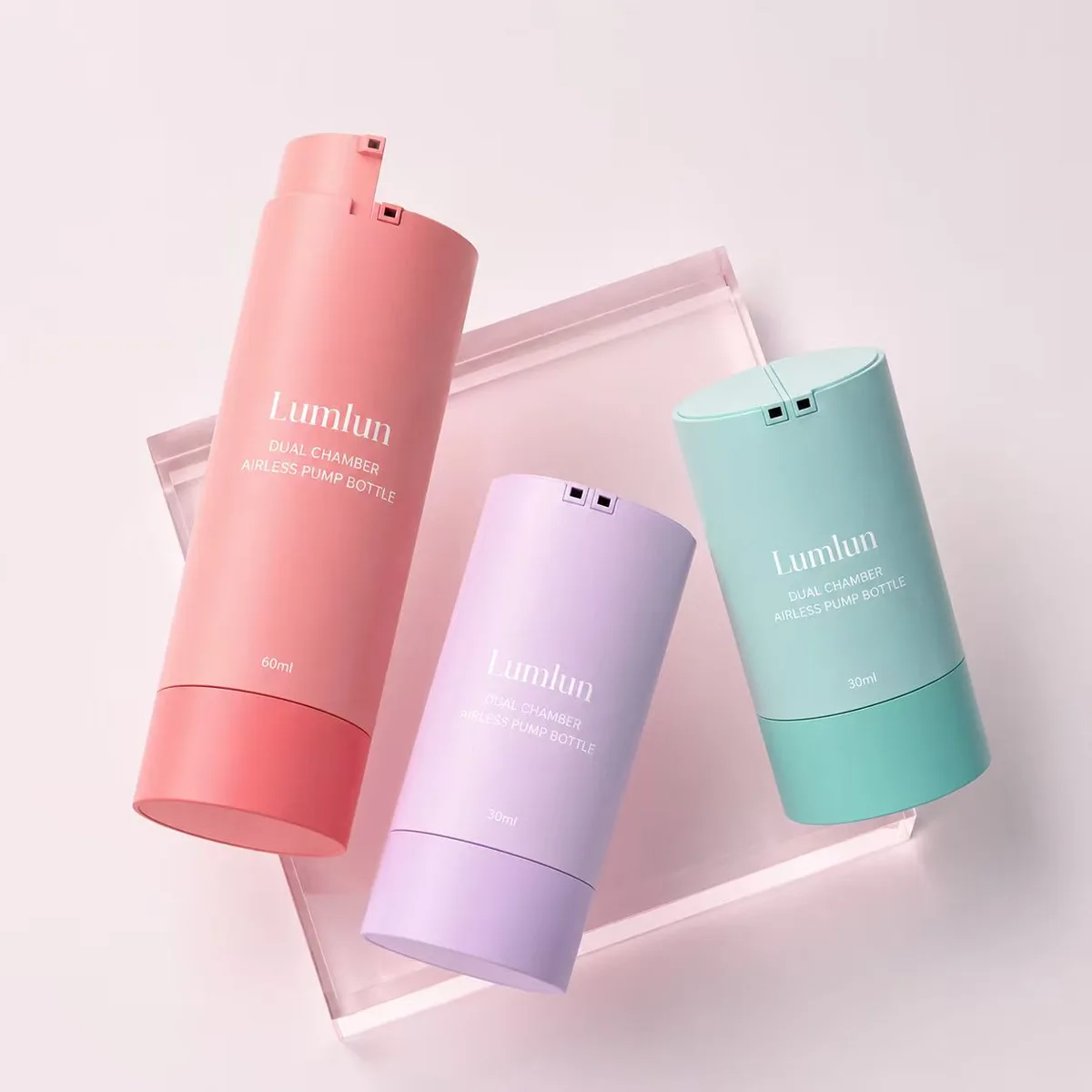
Keep quotation and repeat orders tied to the approved model. A useful quotation should identify the exact dual-chamber model, capacity description, material direction, pump architecture and approved decoration. A generic line such as “dual chamber bottle 60ml” can be ambiguous if several model families exist.
That level of identification protects the buyer as well as production because the sample and purchase order can be tied to the same structure.
Use the exact model reference plus the confirmed capacity wording, material direction and pump arrangement. For example, “2×15ml dual-chamber airless, confirmed model…” is much clearer than “30ml dual bottle.”
The purpose is simple: keep the production order tied to the same structure that was sampled and approved.
Once a model is selected, the drawing should confirm the real external dimensions and the model reference used for artwork and secondary packaging. If the chamber split or pump architecture is relevant to the project, it should be confirmed in the product specification rather than inferred from the drawing alone.
The drawing is useful after model selection; it should not turn the first sourcing conversation into an engineering exercise.
Confirm the exact model, assembled dimensions, pump layout, capacity wording and which side holds which product. Once those are stable, the artwork can use the correct panel sizes and side identification.
Artwork should describe the confirmed package, not be used to guess the package structure.
For a final comparison, keep the two-product relationship visible in every decision. The capacity, pump arrangement, material and decoration should all support the same pair of products. If one change makes the relationship harder to explain or causes one side to become impractical, compare another existing model before adding more complexity.
When the product pair, output method and chamber sizes are all clear, the remaining choices become much easier: select the closest model, confirm the filled sample, then finalize color and decoration on that exact structure.
The same model reference should then remain visible in the quotation, artwork approval and repeat order so every stage refers to the same package.
This also makes later component changes easier to identify and review.
Keep that confirmation with the final production record.
Use the same reference consistently.
Use the capacity language confirmed by the actual model. A product listed as 2×10ml clearly confirms 10ml on each side. A model listed as a 60ml or 100ml overall package should not automatically be described as 30+30ml or 50+50ml unless the internal split is confirmed.
This sounds like a small detail, but it prevents a quotation, artwork or product brief from turning an overall bottle size into an unverified chamber specification.
The approved reference should keep the exact bottle model, chamber capacities, pump architecture, material direction and decoration together. If a pump head or inner chamber changes after the filled sample, the dispensing behavior may also change.
For repeat orders, use the same model reference rather than describing the pack only as “dual chamber 60ml.” That makes purchasing and production refer to the same structure.
The top layout changes the assembled footprint. Yes. Twin pumps, a shared actuator, an overcap or a twist-open top can change total height, width and the space needed above the bottle. This affects the assembled footprint even when the nominal capacity is similar.
Use the real assembled dimensions when the project has a carton or display-size limit. Do not compare only milliliters.
A combined pack is easiest when both products can reasonably be replaced together. If one is a daily moisturizer and the other is a long-lasting occasional treatment, a shared outer pack may create an awkward replacement cycle.
Compare the expected use rate before locking the chamber sizes. Separate bottles remain a valid choice when independent replacement is more useful than one combined package.
Keep the final decision tied to the two-product relationship
| Question | What a clear answer tells you |
|---|---|
| Why are the two products together? | Confirms that dual chamber solves a real product relationship. |
| Together or separately? | Points toward shared actuation or independent pumps. |
| How much of each product? | Sets chamber-size and replacement-cycle requirements. |
| Do both formulas dispense through the selected paths? | Identifies what the filled sample must confirm. |
| Which existing model is closest? | Keeps customization within a real manufacturable structure before tooling is discussed. |
Compare the available LumLun dual-chamber models by real capacity, material and pump layout. If none matches the two-product concept closely enough, contact LumLun and we can compare the nearest existing structure.
You can also compare the wider Airless Bottle & Jar range when the project is still deciding between dual chamber and a simpler single-product airless format.
LumLun currently has several dual-chamber model families, from compact 2×10ml / 2×15ml packs to larger 60ml / 100ml directions and twin-pump models. The correct choice starts with the relationship between the two products, not with color or decoration.