An airless pump bottle is a pump package that dispenses product without relying on the long dip tube used in a conventional pump bottle. In a common piston-based airless system, the product sits above a moving piston. As product is dispensed, that piston gradually rises so the remaining product stays close to the pump.
What Is an Airless Pump Bottle?
The useful difference is the way the package manages product movement and air movement. A regular dip-tube pump draws product through a tube while air replaces the volume leaving the bottle. A common piston airless bottle instead lets the product reservoir move upward with a piston, so it does not need the same long dip-tube route.
The term “airless” describes a dispensing structure, not a guaranteed performance result. It does not by itself prove a fixed shelf life, evacuation percentage, pump output or suitability for every formula. Those results depend on the exact pump, reservoir, materials, formula and finished-package testing.
How Does an Airless Pump Bottle Work?
If you are asking how airless pump bottles work, separate the pump cycle from the movement of the bottle piston. In a typical piston-airless package, one press is better understood as a short sequence:
- Press: the actuator drives the pump mechanism and product already inside the pump chamber is pushed toward the outlet.
- Dispense: product leaves through the nozzle while the inlet path is controlled by the pump’s valve system.
- Release: the pump returns and the pump chamber expands, drawing the next portion of product from the reservoir into the pump chamber.
- Reservoir volume falls: as product leaves the reservoir, a pressure difference develops across the bottle’s moving piston.
- The moving piston follows upward: outside air enters the space below the piston through the bottom vent, allowing atmospheric pressure to help move the piston upward as the product volume decreases.
This is why “press the pump and the bottom piston directly pushes the product out” is an oversimplification. The pump assembly performs the dosing cycle; the bottle piston follows the changing product volume over repeated use.
For a technical example of this separation between the pump assembly, product chamber, moving piston and vented space, see the airless dispensing package described in US11471905B1.

Do Not Confuse the Pumping Element With the Bottle Moving Piston
Many explanations use the word “piston” for more than one moving part. That can make the mechanism sound simpler than it really is.
| Moving element | Where it is | What it does |
|---|---|---|
| Pump piston or equivalent pumping element | Inside the pump assembly | Moves during each press-and-release cycle to change pump-chamber volume and control product intake and discharge. |
| Bottle moving piston / moving base | At the bottom of the product reservoir in a piston-based airless bottle | Gradually moves upward as the overall product volume in the reservoir decreases. |
Not every pump engine uses identical internal parts, so the exact pump mechanism remains model-specific. The important point is that the pump’s dosing motion and the bottle piston’s slow upward movement are different jobs.
What Parts Make the System Work?
| Part | Role in a common piston-airless package |
|---|---|
| Actuator | The part the user presses. |
| Nozzle / outlet | The path where product leaves the package. |
| Pump assembly | Creates the press-and-release dosing cycle. |
| Pump chamber and valve path | Temporarily holds and controls product during intake and discharge. |
| Product reservoir / chamber | Holds the bulk product above the moving piston. |
| Moving piston / base | Follows the product upward as reservoir volume decreases. |
| Bottom vent | Lets outside air enter the space below the moving piston for pressure balance. |
| Bottle body / outer structure | Holds the complete system and provides the visible package form. |
The exact component set varies by model. Some designs add an inner bottle, outer shell, collar, overcap or other parts around the same basic dispensing functions.
See the Mechanism in Three Real LumLun Product Directions
These three LumLun products show how the airless family can appear in different real packaging structures. They are useful product references because not every airless bottle is built around the same internal system.

Gradient Refillable Airless Pump Bottle — 30ml & 50ml
PP + ABS · 30 / 50ml
This 30ml / 50ml PP + ABS model uses a replaceable inner system, giving brands a refillable airless direction. The exact dispensing structure should still be confirmed on the selected model and approved sample.

AS Airless Pump Bottle — 30ml–100ml
AS + PP + ABS · 30 / 50 / 60 / 80 / 100ml
This AS + PP + ABS family is available from 30ml to 100ml. Its exploded view separates the pump/actuator from the moving piston, making the two functions easier to see.
PETG Airless Bottle with EVOH Pouch — 150ml
PETG + EVOH · 150ml
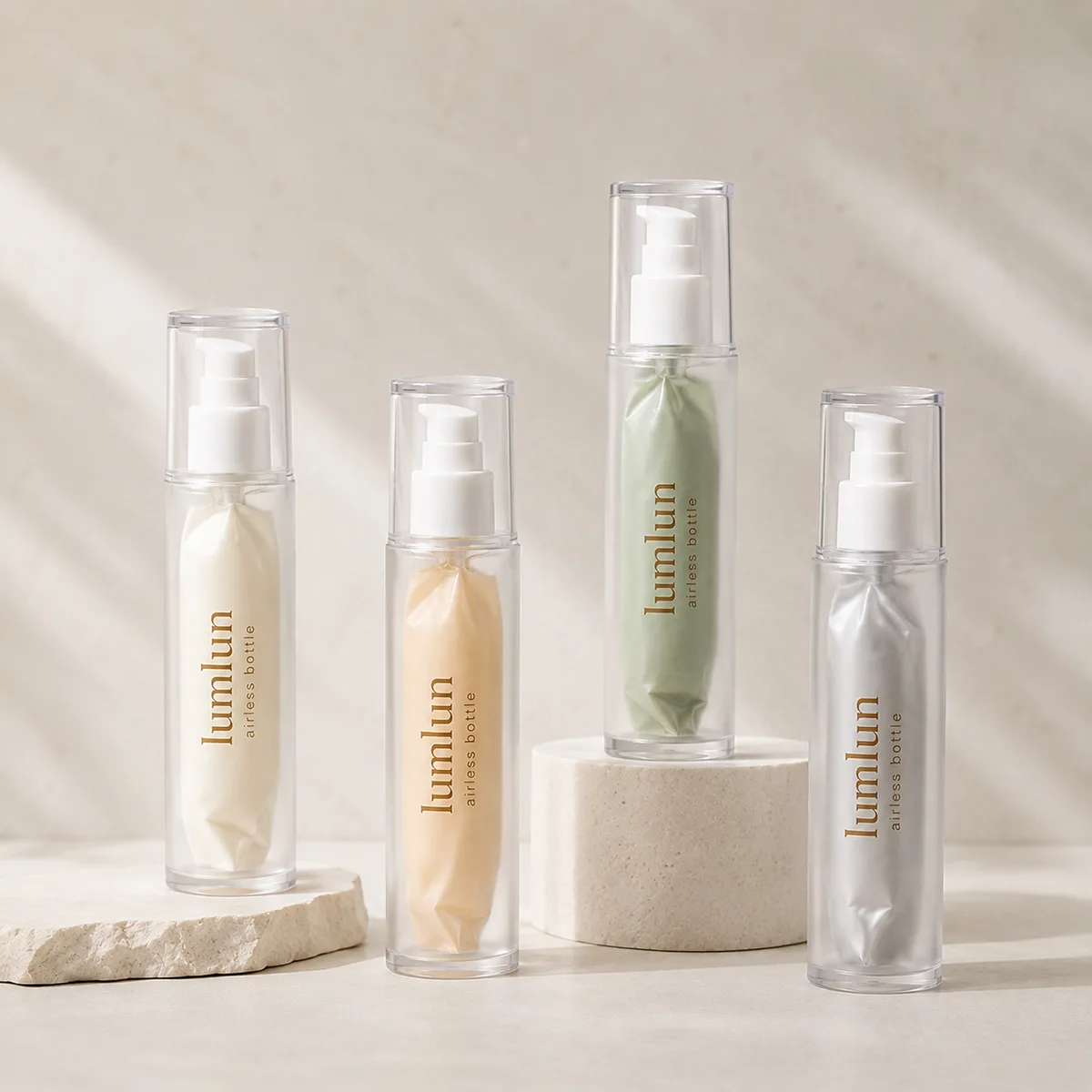
The visible flexible inner pouch shows why Airless is a system family rather than another name for a moving-bottom-piston bottle.
Why Does a Common Airless Pump Bottle Not Use a Long Dip Tube?
A conventional pump bottle normally pulls product from the lower part of the bottle through a dip tube. As the product level falls, air enters the bottle to replace the volume that has left.
In a common piston airless bottle, the remaining product moves upward with the moving base. Because the product reservoir itself is changing position, the package does not need the same long tube extending to the bottom.
| Structure | Common piston airless | Regular dip-tube pump |
|---|---|---|
| How product reaches the pump | The product zone rises with the moving piston | Product is drawn through a fixed dip tube |
| Long dip tube | Usually absent | Usually present |
| How displaced volume is balanced | Air enters below the moving piston | Air enters the bottle headspace above the product |
| Main visible change during use | Moving base rises | Product level falls |
Neither architecture is automatically “better.” A regular pump and an airless pump solve different packaging briefs. If you are deciding whether an airless system fits a real project, our Airless packaging fit guide explains the main selection criteria.

What Is the Small Hole at the Bottom of an Airless Bottle?
On many piston-based airless bottles, the small opening in the base is a vent. It is there so the space below the moving piston can communicate with outside air.
As the moving piston rises, the space underneath it becomes larger. The vent lets air enter that lower space so pressure can remain balanced. The piston separates this lower air space from the product reservoir above.
Not Every Airless Bottle Uses a Moving Bottom Piston
Airless is a packaging-system family, not another name for one piston design. A second real architecture is a pouch / bag-in-bottle system.
In a pouch system, the product sits inside a flexible inner pouch. As product is dispensed, the pouch changes shape and gradually collapses. The pressure-balancing air is outside the pouch rather than below a rigid moving base.
That difference is important when comparing internal airless architectures. If you need to decide which system better fits a project, see our Piston vs Pouch Airless Bottle guide.

What the Mechanism Tells You — and What It Does Not Automatically Prove
| You can understand from the structure | You should not assume from the word “airless” alone |
|---|---|
| A common piston system can work without a traditional long dip tube | A fixed shelf-life extension |
| The bottle moving piston can follow the product upward | “Zero residue” or a universal evacuation percentage |
| A bottom vent can admit air below the moving piston | No oxygen anywhere in the complete package |
| The pump assembly and moving bottle piston perform different jobs | A fixed pump output for every model |
| Airless can use more than one internal architecture | Automatic suitability for vitamin C, retinol or any other specific formula |
| Product path and air path differ from a standard dip-tube bottle | Automatic refillability, recyclability, PCR content or mono-material construction |
For any specific model, performance should be confirmed against the actual pump, reservoir, materials, formula and approved sample.
Explore Airless Packaging for Your Project
Once the mechanism is clear, the practical next step is to compare real packaging options by structure, capacity and project requirements.
Browse the Airless Bottle & Jar Range
Compare current airless bottle and jar directions in one place before narrowing to specific models.
Chat With LumLun on WhatsApp
If you already know your target capacity, formula type or have a reference package, send it directly on WhatsApp and we can discuss suitable airless models.
For a real project, confirm the pump, reservoir, materials and compatibility on the selected model and approved sample before production.