Key Takeaways
- Airless bottles and airless jars use the same airless piston dispensing system — the practical differences are container shape, opening width, standard pump output per stroke, and what sustainability material options are available.
- LumLun’s standard airless bottle comes with a 0.25ml pump; the standard airless jar with a 0.35ml pump. Other output options are available from 0.23ml to 1.00ml per stroke — each pump head delivers one fixed output, selected at the order stage before production begins.
- If your brand requires PCR content or mono-material PP packaging, only the airless bottle currently supports this at LumLun — airless jars are available in standard materials only at this time.
- Both options share the same MOQ (10,000 pcs) and production lead time (30–40 days). Free stock samples ship within 48 hours for both.
- Always test dispensing with your actual formula before confirming your order — pump output and formula compatibility should be verified through a real dispensing test, not assumed.
Your formula is ready. Your brand direction is clear. But when you get to the packaging specification, one question stalls everything: airless bottle or airless jar? Both protect your formula using the same airless piston technology. Both support the same surface finishes and customization. Yet the choice still matters — for how your product sits on shelf, how your consumer uses it every day, and whether your sustainability commitments can be supported by the packaging you choose. This guide breaks down the airless bottle vs jar decision from a B2B OEM sourcing perspective, based on what LumLun — a cosmetic packaging OEM manufacturer based in Zhangjiagang, China, supplying skincare brands across 27 countries — consistently sees in real sourcing conversations.
Same Airless System, Different Container Shape
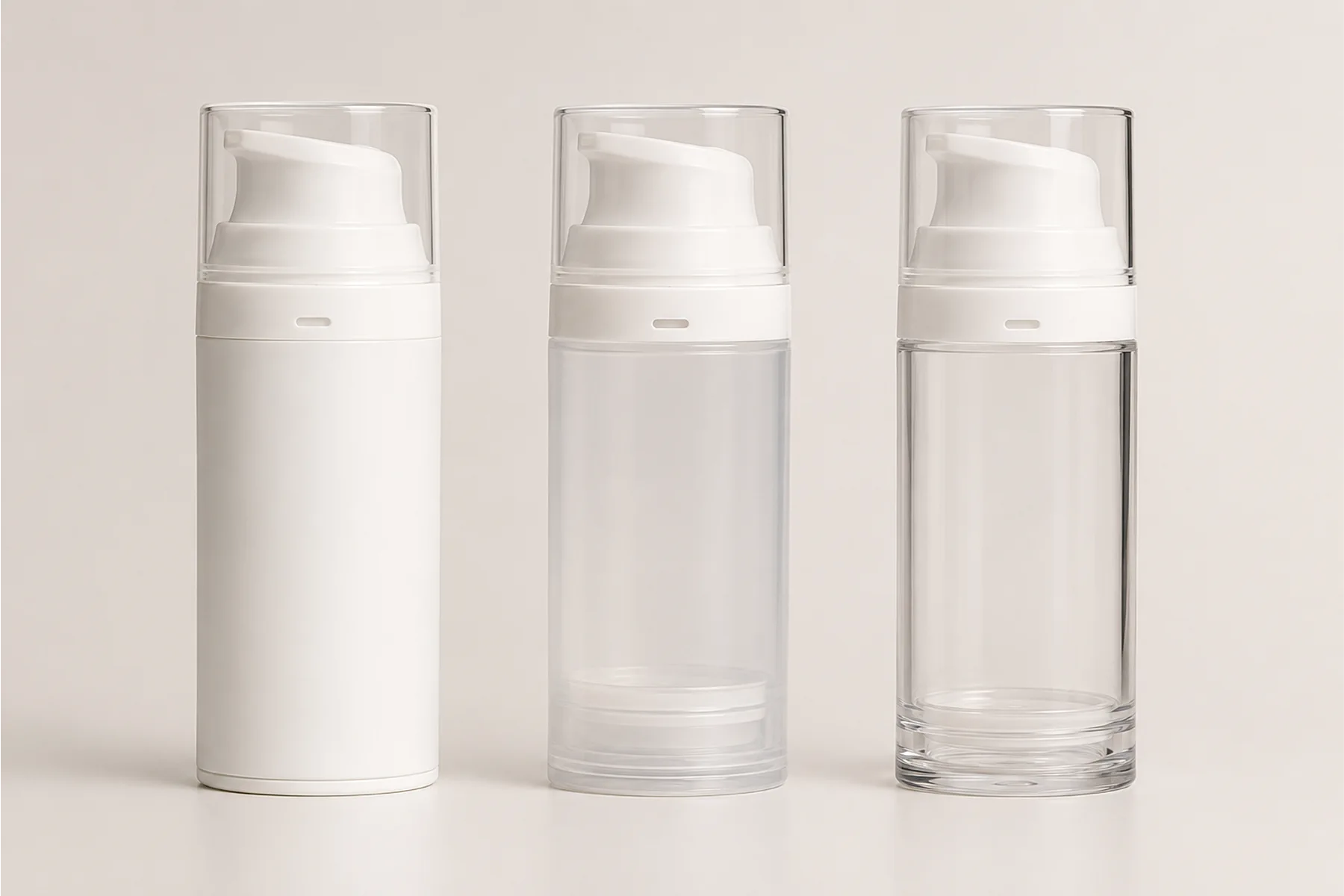
Airless bottles and airless jars both use an airless piston dispensing system. When the pump is pressed, an internal piston moves upward and pushes product toward the nozzle without drawing air back into the container. This mechanism is identical across both container types — the formula protection each provides is equivalent.
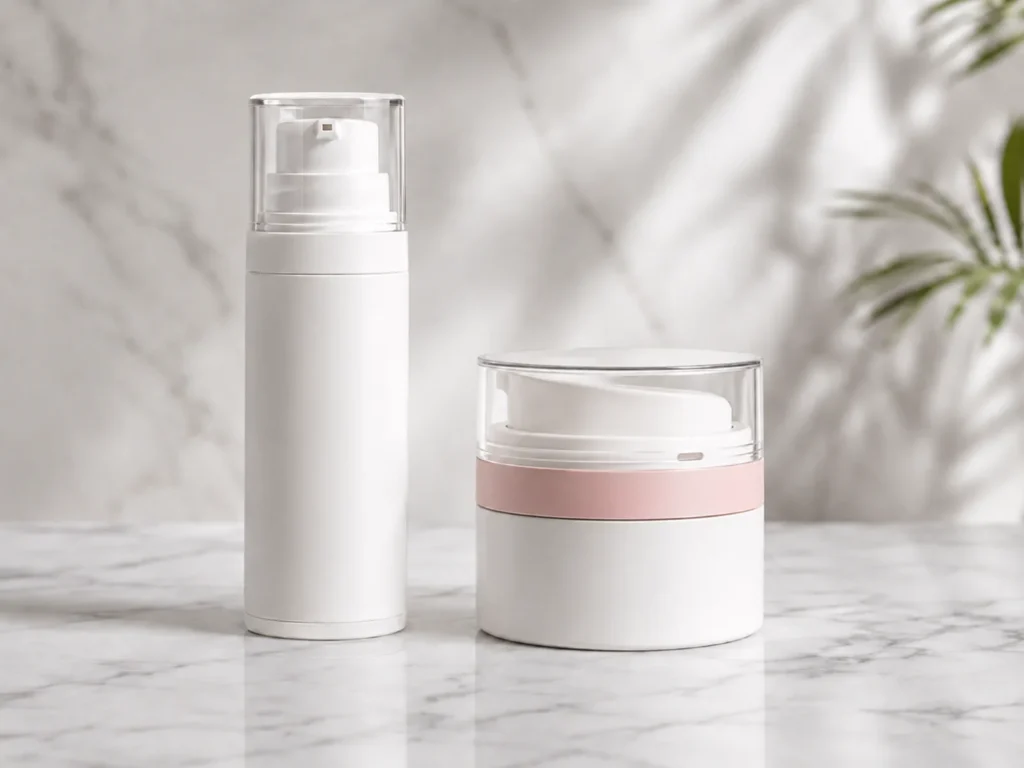
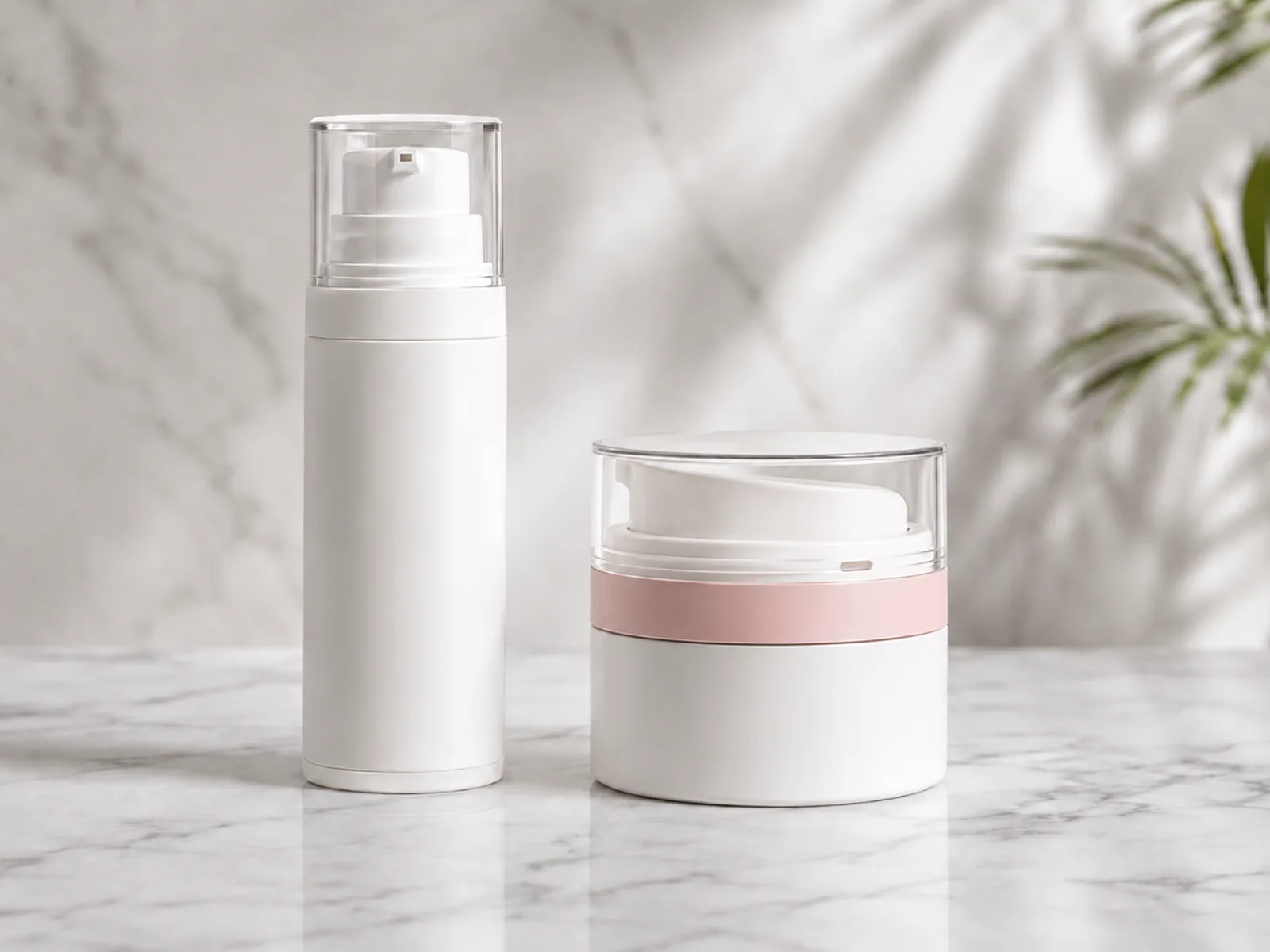
What differs is the container shape and pump configuration. An airless bottle has a tall, narrow body with a conventional pump actuator at the top. An airless jar is shorter and wider, with a broader opening and a flat-press pump surface. Because of its wider internal geometry, the jar uses a different pump configuration — which is why standard pump outputs differ: LumLun’s standard airless bottles come with a 0.25ml pump, and standard airless jars with a 0.35ml pump.
Both containers are available in the same shell materials and support identical surface customization. Both share the same MOQ and production lead time. The areas where they actually differ are container shape, standard pump output per stroke, and sustainability material options.
Why Skincare Brands Switch to Airless Packaging: Real Problems by Formula Type
Brands switch to airless packaging because they’re solving a specific problem with their current containers — whether that’s active ingredient degradation, contamination from open-lid jars, or product waste from dip-tube pumps. The table below maps the most common formula types to their packaging pain points and what airless dispensing addresses.
| Skincare Formula | Common Problem with Standard Packaging | Why Brands Switch to Airless |
|---|---|---|
| Serum / Active Serum vitamin C, retinol, niacinamide |
Standard pump bottles use a dip tube that lets air back into the container with every press, accelerating oxidation of active ingredients | Airless piston dispenses without air returning to the container — active ingredient stability is maintained from first use to last |
| Rich Face Cream | Open-lid jars require finger contact with the formula on every use, introducing bacteria and skin oils into the product | No direct contact with the formula — hygienic dispensing throughout the full product use life |
| Eye Cream | The eye area is particularly sensitive to contamination; open-lid jars create direct bacterial risk at a sensitive application zone | Sealed pump keeps formula protected between uses — reduces contamination risk at a sensitive application area |
| Anti-Aging Cream retinol, peptides, growth factors |
Repeated air exposure from open-lid jars or vented dip-tube pumps degrades unstable actives over the product’s shelf life | Sealed airless system limits air contact with each use — helps maintain active ingredient stability across the product’s full shelf life |
| Lightweight Moisturizer / Lotion | As product levels drop, dip-tube pumps can no longer reach formula that settles below the tube inlet — a portion of product goes unused | Airless piston rises continuously with product use — recovers more of the formula and reduces residual waste per unit |
| SPF / Sunscreen | UV filters and antioxidant actives can degrade with repeated air exposure from dip-tube pumps; packaging integrity directly affects SPF performance over shelf life | Airless piston limits air contact with each press — helps preserve UV filter stability across the product’s full shelf life |
Beyond formula protection, brands that switch to airless packaging also benefit from two additional outcomes. Because the piston advances product continuously throughout use, less residual formula stays trapped at the base of the container — which reduces product waste at scale. And in the skincare retail market, airless containers have become strongly associated with premium, active-ingredient formulations: a packaging choice that communicates product quality to consumers before they read a label. Both of these benefits apply equally to airless bottles and airless jars.
Once you’ve confirmed that airless packaging addresses your formula’s needs, the choice between an airless bottle and an airless jar comes down to three practical factors: pump output per stroke, container shape, and sustainability material options.
Pump Output per Stroke: How the 0.25ml and 0.35ml Standards Work
LumLun’s standard airless bottles come with a 0.25ml pump; standard airless jars come with a 0.35ml pump. If your formula requires a different output, you can specify this at the order stage.
Each pump head is manufactured to deliver one fixed output per stroke — the output cannot be adjusted after production. What you can do is specify the output you need before production begins. LumLun can supply pump heads with outputs from 0.23ml to 1.00ml per stroke. If the standard pump configuration is not suited to your formula, that conversation happens at the order stage — not after your bulk order is confirmed.
When you test stock samples with your formula, assess whether the product releases cleanly from the nozzle, whether the output volume suits a single application of your product, and whether residue builds up after each press. If the standard output does not match your formula’s behavior, discuss the right pump specification with the LumLun team before finalizing your order. For more on pump specifications and capacity options, see LumLun’s custom airless pump bottle guide.
Sustainability: Where Airless Bottles and Jars Currently Differ
If sustainability requirements are part of your sourcing brief, this is the most practically important difference between an airless bottle and an airless jar at LumLun: airless bottles support PCR content and mono-material PP; airless jars do not.
LumLun’s airless bottles are available with post-consumer recycled (PCR) plastic content from 30% to 100%. The recommended ratio for most orders is 30% PCR — this provides meaningful recycled material content while maintaining stable production performance and consistent color output. Airless bottles are also available in mono-material PP, including the pump spring, which enables a single-material design that can enter standard plastic recycling streams without requiring component disassembly.
Airless jars at LumLun are currently available in standard materials only. PCR content and mono-material PP are not available for this container at this time.
For brands aligning with the EU Packaging and Packaging Waste Regulation, or supporting recyclability claims against frameworks such as the APR Design Guidelines for Plastics Recyclability, the airless bottle is currently the only option at LumLun where this is possible. For a full overview of PCR and mono-material configurations, see LumLun’s sustainable airless packaging guide.
Not sure which option fits your formula and requirements? We reply within 24 hours and ship free stock samples in 48 hours.
Container Shape and Skincare Product Category
Both airless bottles and airless jars support the same surface finishes and customization options — Pantone color matching, silk screen printing, hot stamping, frosted or glossy surface treatment, UV electroplating, and gradient spray coating. In terms of visual customization, both formats offer equivalent options.
Where they differ is in how the container shape maps to established product category conventions in skincare retail. The tall, narrow profile of an airless bottle is the shape consumers recognize as belonging to serums, essences, and lightweight skincare treatments. The shorter, wider profile of an airless jar is the shape associated with face creams, rich moisturizers, and eye creams.
In a retail or e-commerce setting, a container shape that matches the product category convention helps consumers recognize what the product is before reading the label. A serum in a jar, or a rich cream in a tall narrow bottle, creates a mismatch between container shape and consumer expectation — which can add unnecessary friction at the point of purchase. Choosing the shape that fits your product category lets the packaging support your product, rather than working against it.
Airless Bottle vs Airless Jar: Complete Comparison
| Airless Bottle vs Airless Jar | Airless Bottle | Airless Jar |
|---|---|---|
| Dispensing Technology | Airless piston | Airless piston |
| Container Shape | Tall, narrow — conventional pump actuator | Short, wide — flat-press pump surface |
| Output per Stroke | 0.25ml (standard); other options: 0.23ml–1.00ml — one output per order, specified before production | 0.35ml (standard); other options: 0.23ml–1.00ml — one output per order, specified before production |
| Capacity Range | 10ml–200ml; most common: 15ml, 30ml, 50ml | Most common: 15ml, 30ml, 50ml — confirm with LumLun for full options |
| Shell Material Options | PP / AS / PETG / PMMA / MS / ABS / PET / Glass | PP / AS / PETG / PMMA / MS / ABS / PET / Glass |
| PCR Content (30%–100%) | ✓ Available — 30% PCR recommended for most orders | ✗ Not currently available |
| Mono-Material PP | ✓ Available (incl. PP spring) | ✗ Not currently available |
| Surface Treatment Options | Silk screen printing, hot stamping, frosted, glossy, UV electroplating, gradient spray coating | Silk screen printing, hot stamping, frosted, glossy, UV electroplating, gradient spray coating |
| MOQ | 10,000 pcs | 10,000 pcs |
| Production Lead Time | 30–40 days | 30–40 days |
| Stock Samples | Free — ships within 48 hours | Free — ships within 48 hours |
Frequently Asked Questions
Do airless bottles and airless jars protect formulas the same way?
Yes — both use the same airless piston dispensing system that prevents air from re-entering the container after each press. The formula protection is equivalent across both containers. The differences lie in container shape, opening width, standard pump output per stroke, and which sustainability material options are available. The right choice between them depends on your formula’s texture and dispensing behavior, your sustainability requirements, and which container shape fits your product line.
Can I fill the same formula into both an airless bottle and an airless jar?
Potentially — but this should be confirmed through dispensing tests before committing to a bulk order. Each pump head delivers one fixed output per stroke, and both containers can be ordered with outputs from 0.23ml to 1.00ml. Whether your formula dispenses correctly depends on how it behaves under the specific pump configuration you specify. Request free stock samples from LumLun, fill them with your actual formula, and evaluate the dispensing before confirming your MOQ.
My brand has sustainability packaging requirements — does that affect whether I should use an airless bottle or an airless jar?
Yes, directly. LumLun’s airless bottles are available with PCR content (30%–100%) and in mono-material PP, including the pump spring. Airless jars are currently only available in standard materials at LumLun — PCR content and mono-material PP are not offered for this container type at this time. If your brand requires verifiable recycled material content or a single-material recyclable design to meet retailer requirements or EU PPWR alignment, the airless bottle is the only option at LumLun that currently supports this.
What is the minimum order quantity, and is it the same for both containers?
Yes — both airless bottles and airless jars have the same MOQ of 10,000 pieces per SKU, with a production lead time of 30–40 days for both. LumLun ships free stock samples within 48 hours for both container types, allowing you to evaluate dispensing and fit before placing a bulk order. If your project requires specifications that stock samples cannot cover, paid custom sampling is also available — contact the LumLun team to discuss your project brief.
How do I choose between an airless bottle and an airless jar before placing a bulk order?
Work through three questions: What is your formula’s texture, and which container is a better starting point for it? Does your brand have sustainability requirements that affect material selection? Which container shape fits the skincare product category you’re launching? Then request free stock samples of both options from LumLun, test dispensing with your actual formula, and confirm the pump output works for your product before finalizing your order specification.
Ready to get started?
Tell us your formula type, target packaging, and any sustainability requirements — we’ll recommend the right option within 24 hours and ship free stock samples in 48 hours.