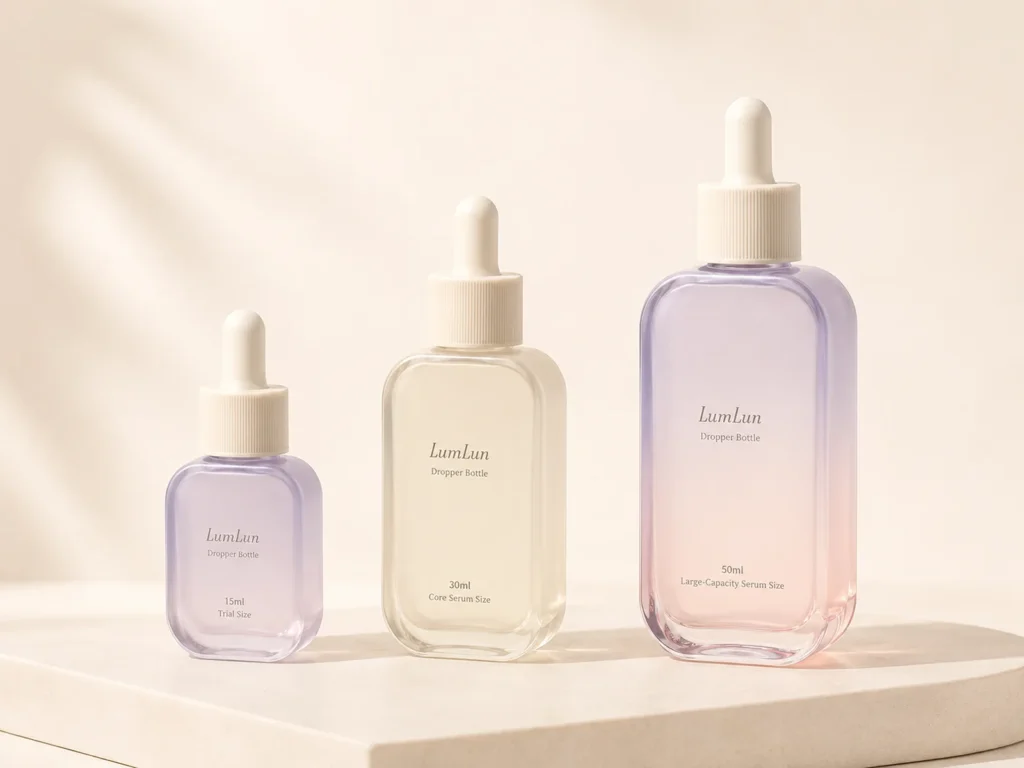
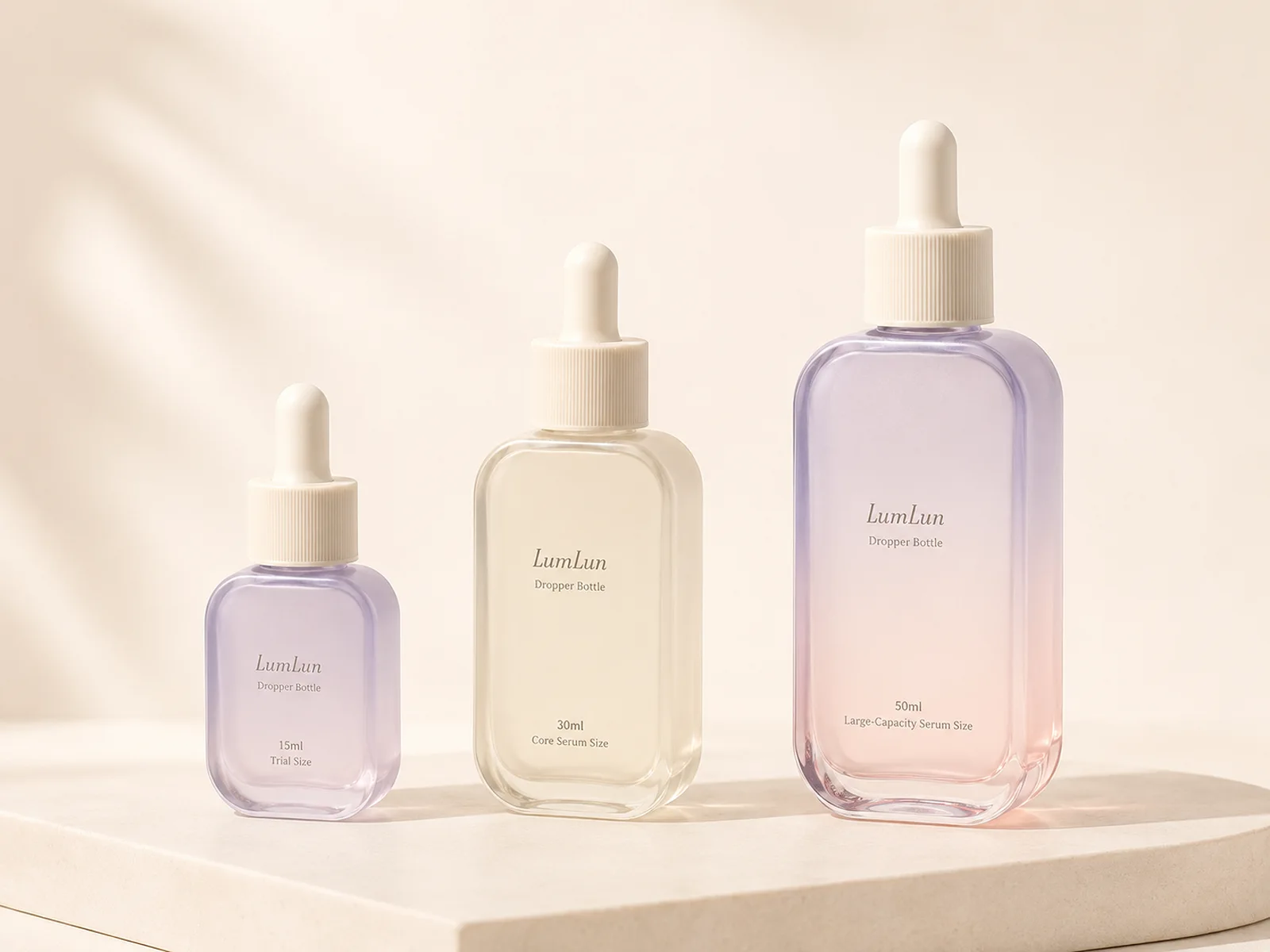
15ml, 30ml and 50ml are all common directions for skincare dropper bottles, but the right size depends on the actual fill plan, how much product is used, the bottle model and the complete dropper assembly. Capacity should be selected from real packaging models rather than from a generic rule that every serum line needs the same three sizes.
For a skincare buyer, the most useful comparison is not whether one size feels more premium or creates a higher-value offer. It is whether the chosen capacity gives the required fill volume, works with the intended dropper, leaves enough space for artwork and fits the secondary packaging and product range.
Start with the fill volume the product actually needs
A 15ml bottle can be appropriate for a concentrated or targeted treatment, but 15ml is not automatically a sample size. A 30ml bottle is widely used for facial serum and facial oil, but it should not be treated as a mandatory industry standard. A 50ml bottle is useful when the product plan genuinely needs a larger fill.
The project should therefore begin with the intended net content and normal use of the product. If the formula is used in very small amounts, a larger bottle can create unnecessary empty time in the product lifecycle. If the product is used more generously, a very small bottle may require replacement too often. These are product-planning questions, not packaging claims.
When 15ml makes sense
A 15ml dropper bottle is useful when the fill itself is intentionally compact: for example, a targeted serum, eye-area treatment, concentrated oil or another product that is used in small amounts. It can also work when a brand wants a smaller SKU alongside a larger bottle, provided the smaller capacity has a clear product purpose.
The main packaging check is proportion. On a 15ml bottle, the bulb, collar and pipette can occupy a larger share of the overall height. The printable body area is smaller, and a wide collar can visually dominate a short bottle. The exact bottle and dropper should therefore be reviewed as one assembled pack.
When 30ml makes sense
30ml is a very common capacity for serum and facial-oil packaging, and search results for cosmetic packaging frequently surface 30ml serum bottles with droppers. That makes it a practical starting point when the planned fill is around 30ml, but the capacity still needs to match the actual product plan rather than a market convention alone.
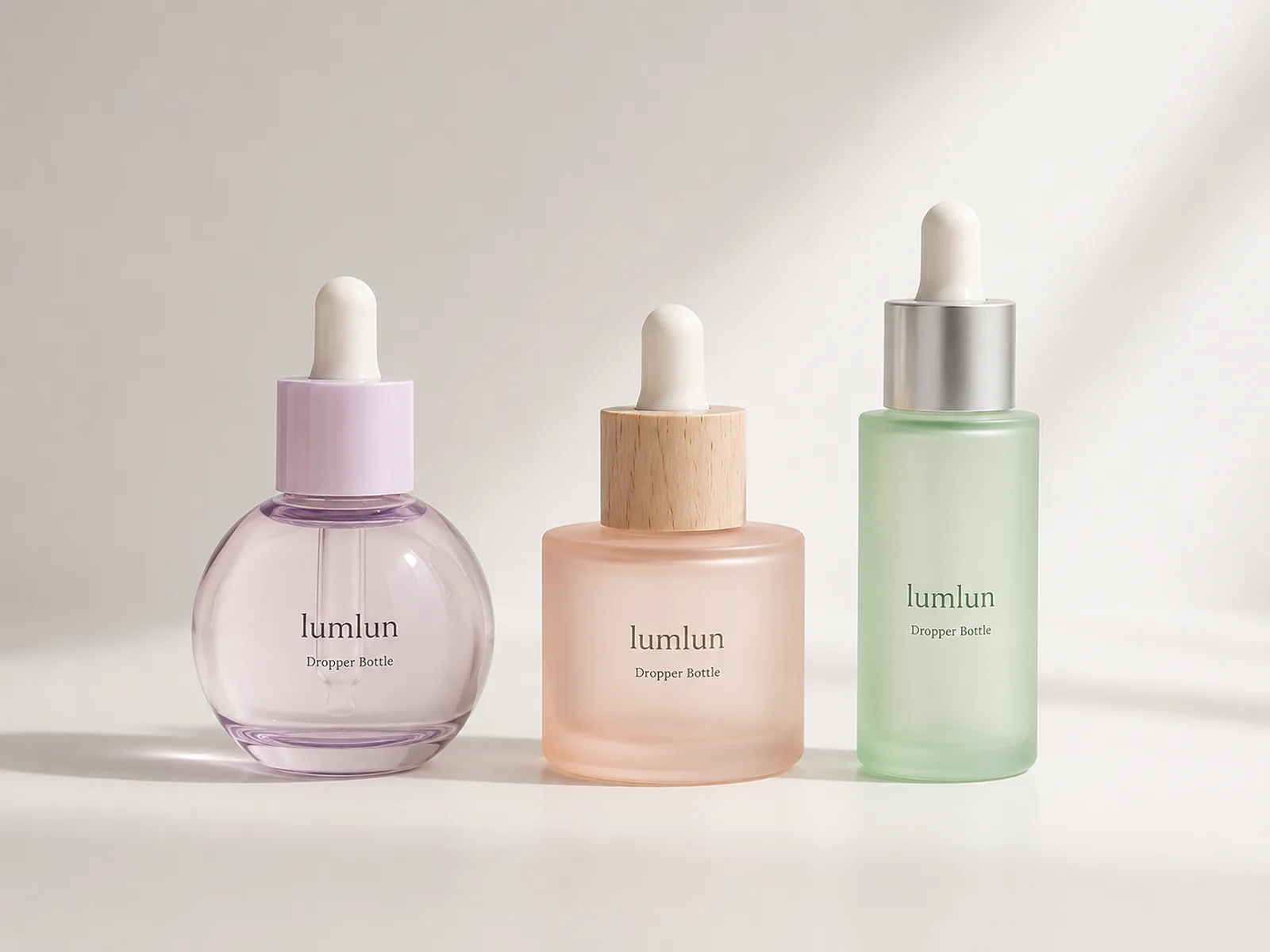
A 30ml bottle also gives buyers many structural choices. LumLun currently has glass, PETG, thick-wall PETG, square PETG, round-shoulder PETG and push-button dropper options around 20–30ml. Those models do not share the same dimensions, neck or dropper assembly, so 30ml should be treated as a fill capacity, not as a standardized bottle shape.
When 50ml makes sense
A 50ml dropper bottle is useful for a serum, facial oil or treatment that genuinely needs a larger fill. It can also be selected when the same bottle series is planned in 30ml and 50ml and the buyer wants two capacities from an existing mold family.
The larger fill usually changes the bottle height, diameter or both. That affects pipette length, assembled height, carton size and the visual balance between bottle body and closure. A 50ml bottle should therefore be compared as a complete pack rather than as a 30ml design simply enlarged on screen.
Do not force a 15ml / 30ml / 50ml ladder when the real model offers other capacities
Actual cosmetic dropper packaging is not limited to three sizes. LumLun currently has a flat-shoulder PETG dropper bottle in 15ml, 30ml, 40ml and 50ml; a press-button PETG+PP dropper in 20ml and 30ml; and glass models that may be available only in 30ml or in another specific combination.
If a 40ml or 20ml option is the closest match to the required fill and structure, there is no packaging reason to force the project into 15ml, 30ml or 50ml. The size page should help buyers compare real capacity options, not create an artificial three-size rule.
Nominal capacity does not tell you the external dimensions
Two 30ml dropper bottles can look and pack very differently. A tall cylindrical bottle, a wide round-shoulder bottle, a square bottle and a thick-wall bottle can all carry the same nominal capacity while using different height, diameter, base thickness and internal volume geometry.
For secondary packaging, line drawings and carton development, use the actual dimensions of the selected model. Do not estimate carton size from the milliliters alone.
Pipette length must match the selected bottle height
Changing bottle capacity often changes the required pipette length. The pipette needs to reach the intended position inside the bottle without being incorrectly forced against the base. The assembled dropper also needs to match the bottle neck and closure system.
This is why a 15ml, 30ml and 50ml range should not be built by choosing three unrelated bottles and assuming the same dropper top can be transferred between them. The closure and pipette belong to each confirmed bottle construction.
Compare the assembled height, not only the bottle body
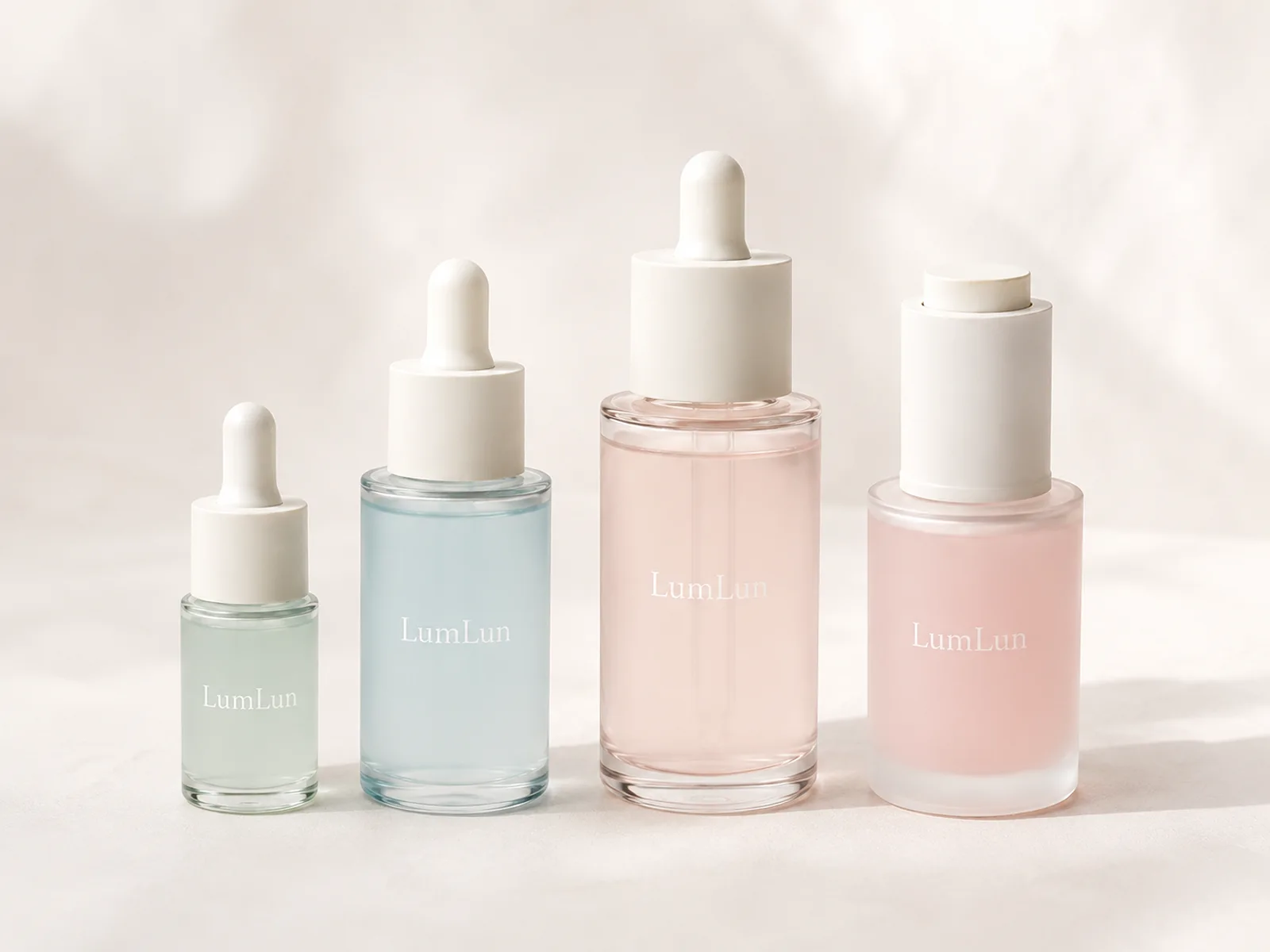
The packaging used in artwork, cartons and product photography is the assembled bottle: body plus collar or cap, bulb or push button, and pipette. A compact 15ml body can become relatively tall once the dropper is installed, while a wide 50ml bottle can remain visually low.
When the product range must fit a shelf tray, gift box or shipping insert, request the assembled dimensions of each capacity. This is more useful than comparing body height alone.
Bottle shape can change how much usable artwork area you have
Capacity and printable area are related, but not in a simple linear way. A tall 30ml bottle can offer a long narrow print area. A wide 30ml bottle may provide more width but less vertical space. A square bottle creates different front panels from a round bottle.
If the front panel must carry a long product name, volume declaration or several required design elements, confirm the actual artwork area before locking the bottle. Do not scale the same artwork mechanically from 15ml to 30ml to 50ml.
Keep material choice separate from size choice
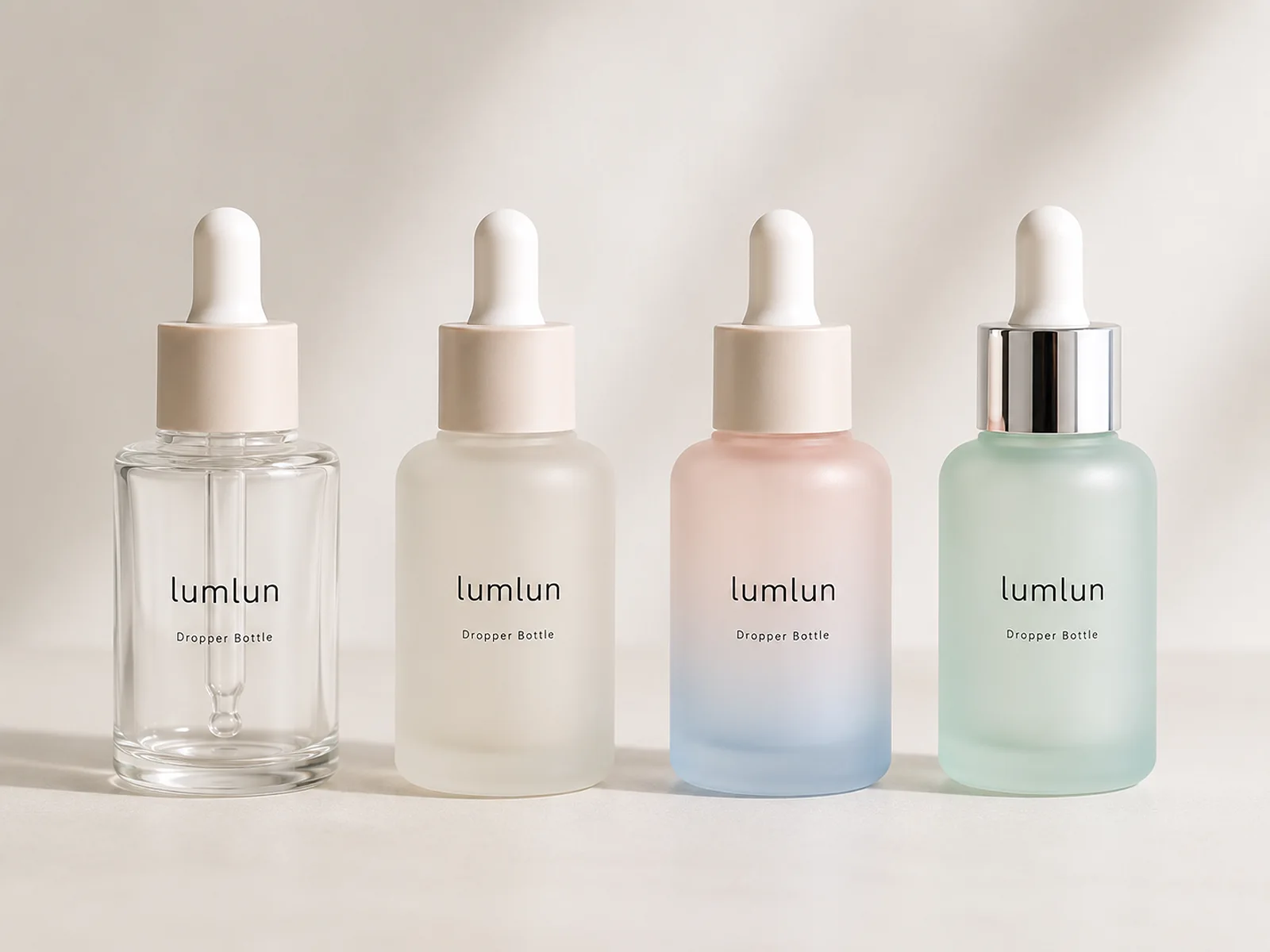
15ml, 30ml and 50ml can exist in glass or plastic dropper packaging, but not every material is available in every LumLun bottle. A capacity decision should not silently become a material decision.
If the project still needs to compare PETG and glass dropper bottles, make that material decision separately and then confirm which capacities exist in the chosen bottle family.
The dropper style can also limit which capacities belong together
A traditional rubber-bulb dropper and a push-button dropper are different closure systems. A 20ml/30ml push-button family should not be described as the same packaging series as a 15ml/30ml/50ml bulb-dropper family unless the supplier has confirmed that relationship.
For a multi-size range, decide whether all capacities really need the same dispensing action. If they do, compare model families that already offer the required sizes with a consistent closure structure.
Consider normal product use without turning it into a dosage claim
A buyer can use expected product use to estimate whether 15ml, 30ml or 50ml is a sensible fill, but a cosmetic dropper should not be treated as a calibrated dosing device unless the actual assembly has been validated for that purpose.
The number of drops or full pipettes per bottle cannot be calculated reliably from capacity alone. Formula viscosity, pipette geometry, bulb pressure, fill level and user action all affect the delivered amount.
One serum line does not always need multiple sizes
If the project has one core serum, launching one confirmed capacity can be simpler than creating 15ml, 30ml and 50ml versions without a clear need. Multiple capacities are useful only when each SKU has a defined fill requirement or a distinct use case.
When several sizes are required, using one real bottle family can simplify proportion, closure matching and artwork development. If no single family offers all required capacities, it is better to compare two compatible model directions than to assume a new size can be created without tooling.
Capacity affects secondary packaging and case packing
A change from 30ml to 50ml can alter carton height, carton width, insert design and how many units fit in an export carton. A 15ml bottle may need a different insert so the dropper top is protected during transport.
These are model-specific packaging dimensions. The correct values should come from the chosen assembled bottle, not from a generic size chart.
Confirm fill line and usable bottle volume with the supplier
The printed capacity on a product page identifies the nominal model size. The actual filling process still needs the supplier’s bottle specification and the finished product’s fill plan. Buyers should not assume that the visible shoulder or the top of a clear bottle is the intended fill line.
This point matters especially with thick-wall PETG or glass bottles, where the external size can look larger than the internal product volume suggests.
Capacity changes the bottle specification, not just the label
When a project moves from 15ml to 30ml or 50ml, the supplier may be moving to a different mold, different pipette length, different assembled height and sometimes a different neck or closure configuration. The capacity field should therefore be treated as part of the packaging specification, not as a number that can be changed after artwork is complete.
For quotation and production control, each size should have its own confirmed bottle model, capacity, material, closure, pipette and decoration reference. This is especially important when two capacities look similar in product images but are not the same mold family.
Do not use capacity to imply how long the formula will last
A 50ml bottle contains more product than a 30ml bottle, but the package size alone cannot determine a fixed number of weeks or months of use. Daily application amount, number of applications, formula instructions and user behavior all affect consumption.
The packaging decision should stay at the level the buyer can verify: net content, bottle size, dropper fit, filled appearance and whether the selected capacity matches the planned product specification.
Wiper or reducer fit can change with the bottle and closure
Some dropper packs use a wiper or reducer around the neck to manage product on the outside of the pipette. If the 15ml and 50ml bottles use different neck or closure structures, the same wiper should not be assumed to fit both.
This is another reason to compare complete assemblies by size. The buyer does not need to specify the wiper geometry at first contact, but the final approved pack should identify the actual components used for each capacity.
Multiple capacities are separate SKUs for planning and approval
A 15ml, 30ml and 50ml range may share one color system and artwork direction, but each capacity is still a separate packaging specification. Decoration position, print size, carton dimensions and sample approval need to be checked on each bottle.
LumLun's general OEM MOQ is 10,000 pieces, but the final MOQ and order structure should be confirmed against the selected model, capacity, components and decoration. Do not assume that one total quantity can always be divided freely across several bottle sizes.
Use real LumLun models to compare the size options
| LumLun example | Confirmed capacities | Confirmed material | What the buyer can compare |
|---|---|---|---|
| PETG Thick-Wall Dropper Bottle | 15 / 30 / 50ml | PETG | One existing family covering the three common capacities |
| Flat-Shoulder PETG Dropper Bottle | 15 / 30 / 40 / 50ml | PETG | Adds a 40ml option and a different shoulder/profile |
| Square Thick-Wall PETG Dropper Bottle | 30 / 50ml | PETG | Two-size square bottle direction |
| Press-Button Dropper Bottle | 20 / 30ml | PETG + PP | Different dropper mechanism and different capacity range |
| 30ml Matte Glass Dropper Bottle | 30ml | Glass | Single-capacity glass model |
The table is not a mix-and-match component list. Each row is a separate bottle model or existing bottle series. Capacity, neck, closure and pipette should remain tied to the selected packaging.
A stock sample and a filled sample answer different size questions
A stock sample is useful for checking the actual bottle dimensions, hand feel, closure proportion, pipette length and artwork space. A filled sample is more useful when the buyer needs to see the product level, formula visibility, dropper draw and normal handling.
There is no need to request a long technical checklist before the first conversation. A product link, a reference image or the approximate capacity direction is enough to start comparing real models.
15ml vs 30ml vs 50ml: a practical comparison
| Capacity direction | Useful when | Main packaging checks | Do not assume |
|---|---|---|---|
| 15ml | The finished product intentionally needs a compact fill | Closure proportion, print area, pipette length, carton insert | That it is automatically a sample or travel size |
| 30ml | The planned serum/oil fill is around 30ml and a broad model choice is useful | Bottle dimensions, neck/closure, artwork area, material | That all 30ml bottles share one shape or dropper |
| 50ml | The product genuinely needs a larger fill or a 30/50ml family | Pipette length, assembled height, carton size, bottle width | That a 30ml design can simply be enlarged |
| 20ml / 40ml / other | A real model or fill plan fits better | Availability in the chosen bottle series | That every serum range must use 15/30/50 |
A simple order for choosing the size
- Confirm the intended net content and normal product use.
- Find real dropper bottle models that offer that capacity.
- Compare bottle dimensions and assembled height.
- Confirm the neck, closure and pipette for each capacity.
- Check artwork area and secondary packaging.
- Use a physical sample before production when proportion or filled appearance matters.
If the broader question is how to choose the entire dropper pack, use the skincare dropper bottle selection page. If the product may work better with another dispenser, compare dropper bottles and airless pumps before locking the capacity.
Current dropper models can be browsed in the LumLun Dropper Bottle collection. If you already have a preferred bottle or reference image, you can start from that through Contact; the remaining details can be confirmed after the closest model is identified.