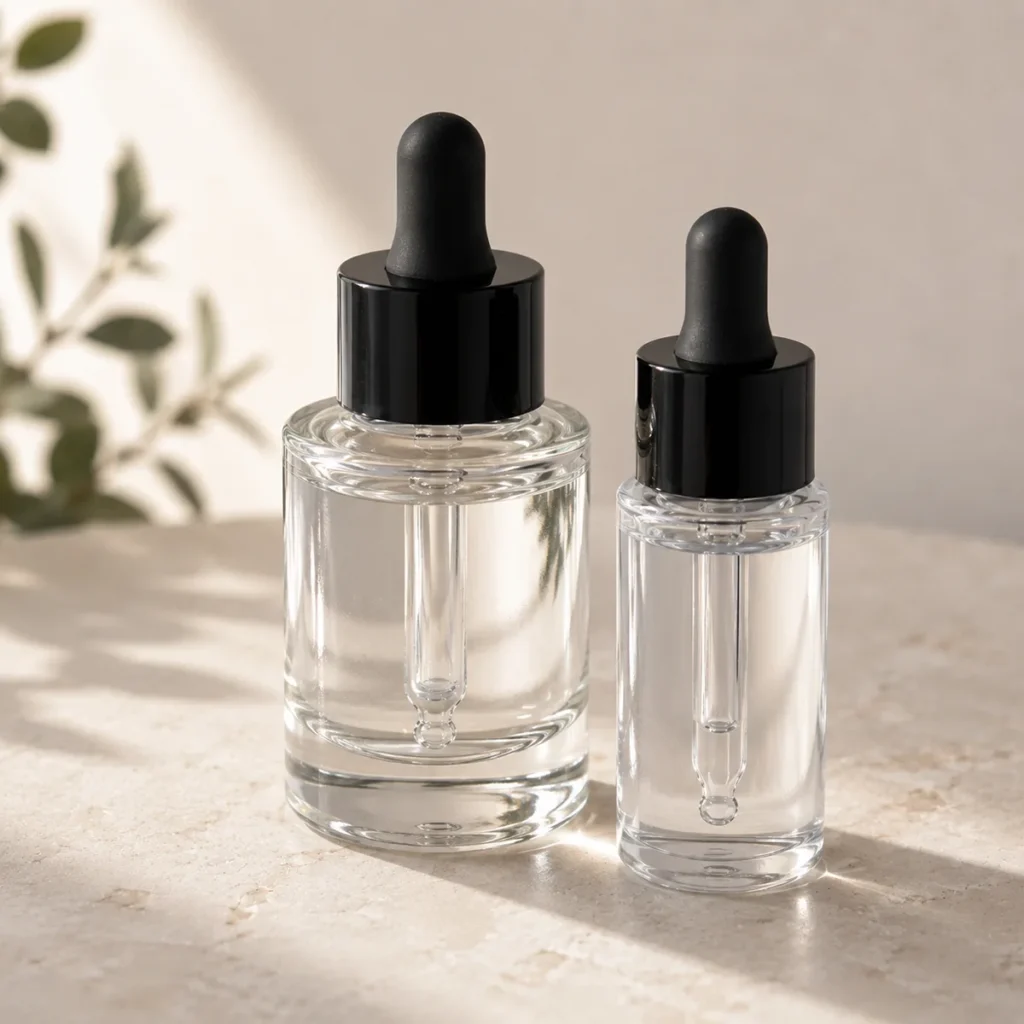
PETG and glass can both be used for skincare dropper bottles, but they solve different packaging requirements. The useful comparison is not “plastic versus premium glass.” It is impact behavior, unit weight, bottle geometry, clarity, decoration, formula-contact construction, shipping pack and end-of-life evidence for the exact material and market.
PETG should not be grouped together with PET as if they were the same bottle material, and glass should not be treated as automatically better for every serum. Buyers should compare real bottle models and confirm the complete dropper assembly rather than choosing from a material name alone.
Start with the requirement that is actually driving the material decision
If glass breakage during normal handling or distribution is a real project concern, a PETG bottle may be worth comparing because a tough plastic body does not fail in the same brittle way as glass. If the project specifically requires a rigid glass container, glass remains the direct material choice.
Other projects begin with weight, bottle shape, transparency, decoration or an existing product specification. The material decision should follow the actual requirement instead of a rule that one material is always more premium, more sustainable or more protective.
PETG is a copolyester plastic, but exact resin grade still matters
PETG is used in cosmetic packaging because it can be molded into clear, shaped and thick-wall plastic parts. However, the properties of one copolyester grade should not be copied automatically to every PETG bottle.
Eastman, for example, publishes clear copolyester grades with high clarity, toughness and impact resistance, and other cosmetic-packaging copolyesters that are specifically engineered for PET-stream recyclability. Those resin-level examples are useful because they show that copolyester performance is grade-specific. They are not proof that an unspecified LumLun PETG bottle has every listed property.
Glass is rigid and can break; bottle construction still matters
A glass dropper bottle has a rigid glass wall and can chip or break under impact. The actual breakage risk depends on bottle geometry, wall distribution, handling, internal packing, shipping carton and the conditions the filled pack experiences.
That is why a buyer should not use a universal breakage percentage from another brand or another bottle. If breakage is an important purchasing criterion, compare the selected glass bottle and PETG bottle under the shipping and handling conditions that matter to the project.
PETG reduces glass-shard breakage, but it is not damage-proof
PETG does not create glass shards when it is dropped, which can make it useful for projects where broken glass is a practical handling concern. The bottle can still scratch, scuff, deform or crack depending on the resin, wall, design and impact.
The correct wording is therefore lower fragility compared with glass for a confirmed PETG bottle, not “unbreakable,” “shatterproof in every condition” or “zero shipping damage.”
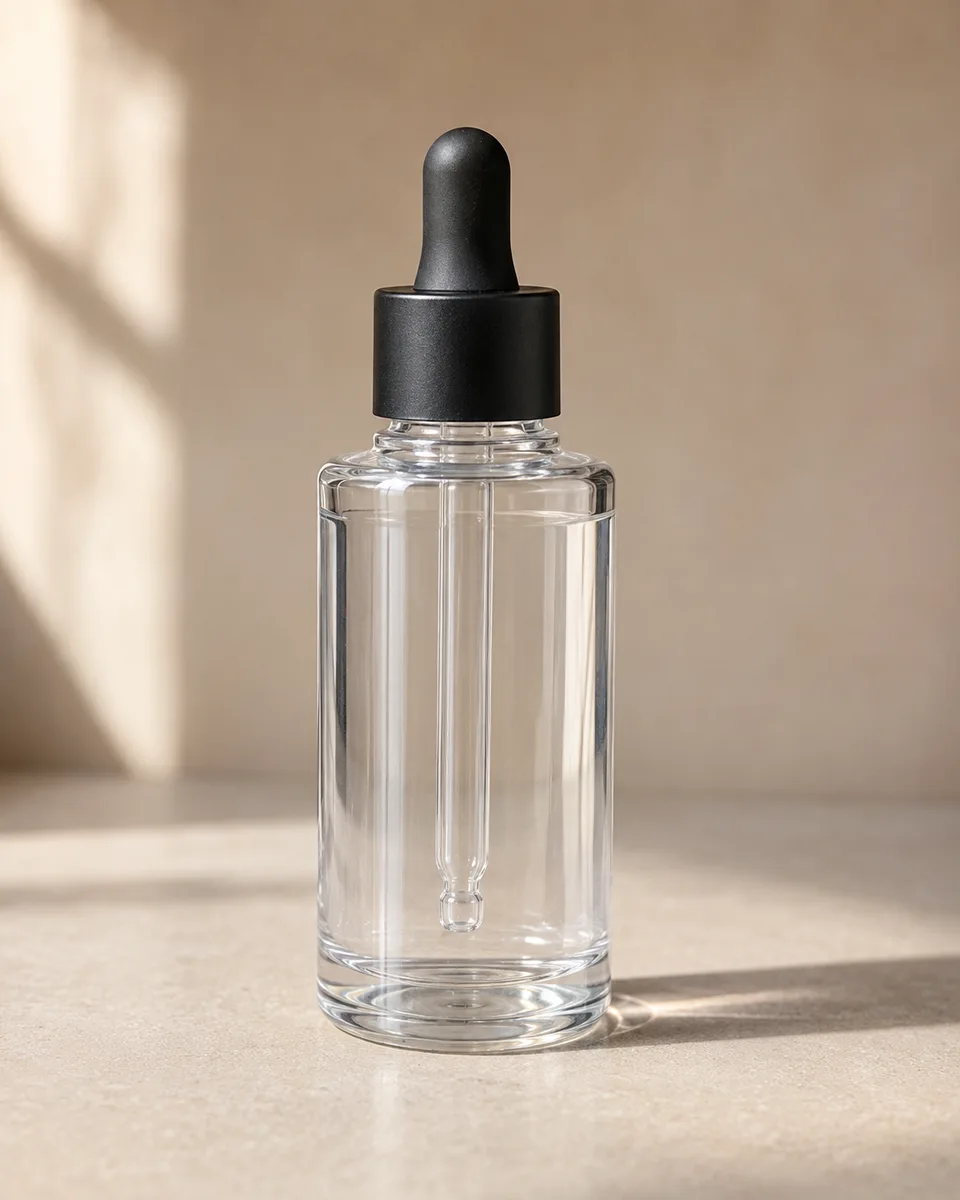
Compare actual unit weight instead of assuming all plastic bottles are light
PETG bottles are often selected when a project wants a plastic body and lower handling weight than a comparable thick glass bottle, but thick-wall PETG can still be substantial. A small glass bottle can also weigh less than a much larger plastic design.
When weight affects freight, carton loading or the way the pack is handled, request the unit weight of the exact assembled bottle and compare it with the actual glass alternative.
Thick-wall PETG and glass can both look clear, but the appearance is not identical
A thick-wall PETG bottle can provide high clarity and a substantial wall section. Glass has its own optical characteristics, base shape and edge appearance. The difference is easiest to judge from physical samples rather than from the phrase “glass-like.”
If the package must remain transparent, compare filled samples for haze, tint, wall thickness, internal reflections, pipette visibility and how the formula color appears through the bottle.
Bottle stiffness changes how the pack feels during handling
Glass is much more rigid in normal cosmetic-bottle use. PETG is a plastic and its stiffness depends on wall thickness and geometry. A thick PETG bottle can feel structurally substantial without behaving like glass under impact.
This is useful for procurement because the material choice can change drop behavior, carton protection and the way the bottle is handled on a filling line. It should not be translated into vague language such as “premium hand feel.”
Formula compatibility must be confirmed for the complete package
A material name alone does not prove compatibility with every serum or facial oil. The finished formula may contact the bottle wall, pipette, gasket, wiper, liner or other closure parts depending on fill level, storage and normal use.
For either PETG or glass, compatibility review should use the exact bottle and the complete dropper assembly. Do not assume that choosing glass eliminates all contact-material questions, and do not assume that a generic PETG compatibility statement applies to the specific resin and decoration used.
Do not use PETG vs glass to answer Amber vs Clear
Material and bottle color are separate decisions. A glass bottle can be clear, amber, frosted or coated. PETG can also be clear, tinted, frosted or coated where the model and process allow.
If the real requirement is light transmission through amber versus clear glass, use the Amber vs Clear Glass Dropper Bottle comparison. PETG vs glass should remain a material and handling decision.
Decoration needs to be approved on the actual bottle material
Silk-screen printing, hot stamping, coating, frosting, gradient color and other decoration can be available on both glass and PETG models, but process windows and surface preparation are material-specific.
Do not approve artwork on a glass sample and assume the same ink, coating or metallic effect will reproduce identically on PETG. Decoration should be sampled on the selected bottle material and surface.
The dropper closure can make the complete pack more similar than the bottle bodies suggest
A PETG bottle and a glass bottle may both use a rubber bulb, plastic or metal-sheathed collar and glass pipette. In that case, changing the bottle body material does not change every component in the pack.
For material declarations, recycling analysis and compatibility work, record the bottle body and the dropper assembly separately.
Shipping performance depends on the complete packed unit
PETG is often chosen when breakage during handling or e-commerce distribution is a concern, but the bottle is only one part of shipping performance. Carton strength, dividers, inserts, case pack, closure security and filled weight all affect the result.
Glass may require more protective packing in some projects. PETG may allow a different packing approach. Neither outcome should be assumed until the actual packaging configuration is reviewed.
Recyclability cannot be concluded from the word PETG
A common mistake is to see PETG and assume it belongs in the same recycling stream as every PET bottle. Resin chemistry, additives, color, size, labels, closures and local collection all matter.
RecyClass evaluates packaging against specific recycling streams and complete-pack design features in its Design for Recycling Guidelines. Some newer copolyesters are specifically engineered for PET-stream compatibility, which further shows why the exact resin grade must be known before making a recyclability claim.
Glass recycling also depends on the collection system and complete pack
Glass packaging has established collection and bottle-to-bottle recycling systems in Europe. FEVE reports high collection-for-recycling rates for container glass and describes cosmetic glass as part of the closed-loop packaging stream. That is useful background, but it does not mean every decorated dropper pack is automatically recycled in every market.
If this end-of-life question matters to the project, review the local collection route and complete components rather than relying on a generic “glass is endlessly recyclable” statement. The FEVE container-glass recycling data provides European context, not a universal claim for every market.
PETG and PET are not interchangeable material names
PET and PETG are different polyester materials and may behave differently in molding and recycling systems. A product page that says PETG should not be rewritten as PET merely because both names begin with PET.
This distinction is especially important in quotations and sustainability documentation. The exact bottle resin should be confirmed rather than inferred from appearance.
Changing the bottle material can also change the neck and closure choice
A PETG bottle and a glass bottle with the same nominal capacity do not necessarily use the same neck finish, collar, gasket, wiper or pipette length. The dropper top from a 30ml glass bottle should not be assumed to fit a 30ml PETG bottle simply because both are sold as serum droppers.
If a project is switching material while trying to keep the same visual design, the buyer should compare the assembled closure as well as the bottle body. A material change can alter total height, shoulder-to-collar transition and the visible proportion of the pipette inside a clear bottle.
Leakage belongs to the complete closure system, not to PETG or glass alone
A glass bottle is not automatically leak-proof, and a PETG bottle is not automatically more or less secure. Leakage depends on the neck, closure engagement, gasket or liner, pipette assembly, filling conditions and transport orientation.
If leakage is a project concern, compare the actual filled pack under the relevant handling conditions. Do not choose the body material based on a generic leakage claim.
Surface appearance should be checked after real handling
A clear PETG bottle and a clear glass bottle can both look very clean when new. During packing and transport, however, the bottle surface, coating and decoration are exposed to rubbing against trays, dividers and neighboring units.
If scuffing, coating durability or print adhesion matters, compare decorated samples rather than making a material-wide claim. The answer may depend more on the selected coating and secondary pack than on the bottle body alone.
Existing model availability can matter more than the theoretical material preference
A buyer may prefer glass in principle but need a square 50ml bottle that is readily available only in PETG, or prefer PETG but need a specific glass shape, tint or closure that already exists as a proven model. In those cases, comparing existing molds can save unnecessary tooling work.
The practical path is to identify the closest existing PETG and glass options, compare the complete specification, and only discuss new tooling if neither existing structure can meet the required geometry or function.
MOQ and sample approval should be attached to the selected model
LumLun's general OEM MOQ is 10,000 pieces. The final order terms still belong to the selected bottle, capacity, dropper components and decoration. A PETG and glass alternative should be quoted as two complete specifications rather than as two material names.
For the first conversation, a product link or reference image is enough. Once the closest models are identified, samples can be used to compare weight, clarity, dropper fit, filled appearance and decoration without asking the buyer to prepare a full technical dossier first.
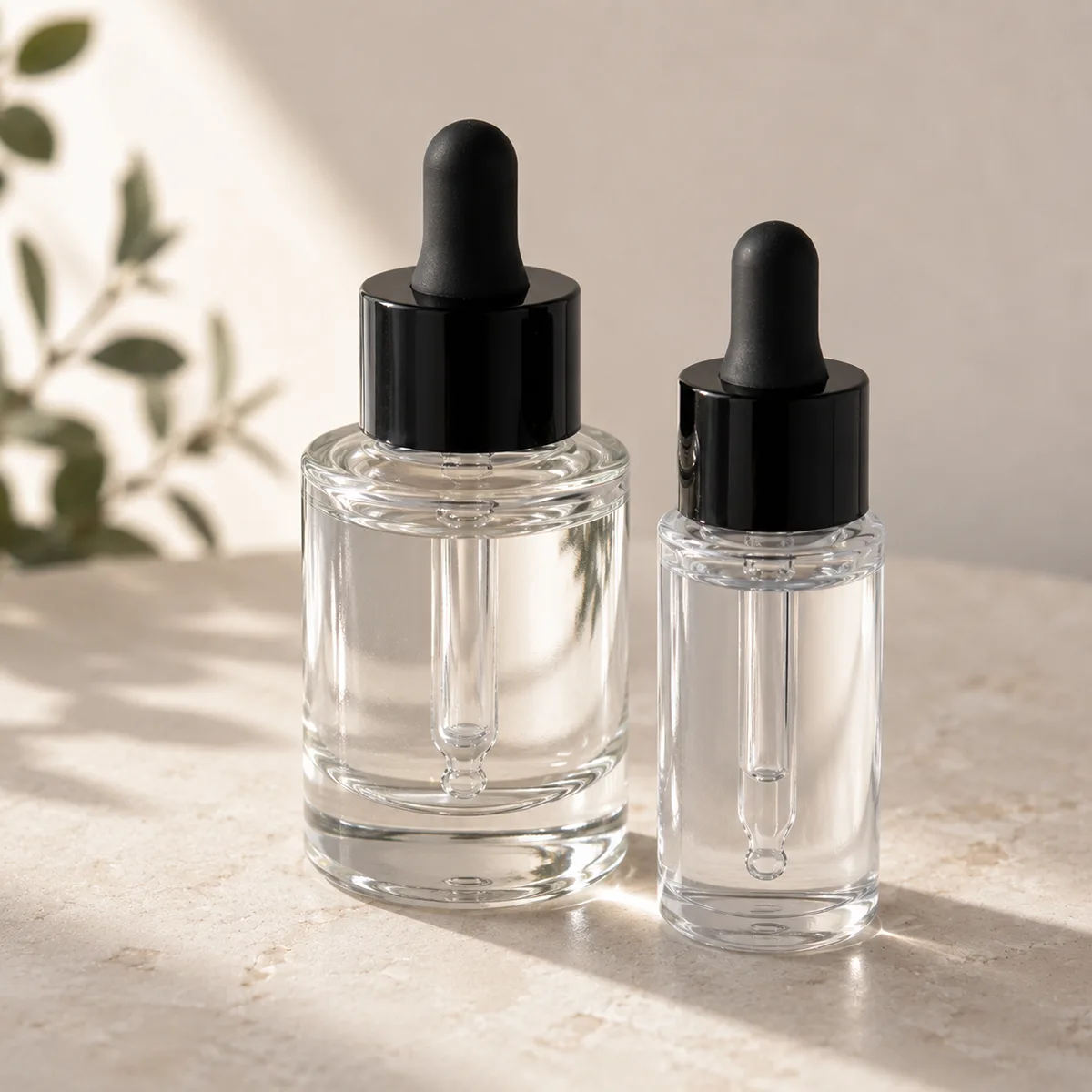
Compare real LumLun PETG and glass dropper models
| LumLun example | Capacity | Confirmed bottle material | Useful comparison point |
|---|---|---|---|
| PETG Thick-Wall Dropper Bottle | 15 / 30 / 50ml | PETG | Multi-capacity thick-wall plastic bottle |
| Square Thick-Wall PETG Dropper Bottle | 30 / 50ml | PETG | Square PETG geometry |
| Round-Shoulder PETG Dropper Bottle | 30 / 50ml | PETG | Wide round-shoulder PETG profile |
| 30ml Matte Glass Dropper Bottle | 30ml | Glass | Single-capacity matte/frosted glass direction |
| UV-Tinted Glass Dropper Bottle | 30ml | Glass | Tinted glass bottle with two cap directions |
These are separate packaging models. Do not combine the PETG bottle body from one row with the glass cap or capacity from another row unless the supplier confirms that exact configuration.
Cost should be compared as a complete quoted pack
There is no reliable rule that PETG is always cheaper than glass or glass is always more expensive. Resin, glass weight, wall thickness, bottle geometry, dropper components, decoration, secondary packing and quantity all affect quotation.
For a useful comparison, quote two complete bottle-and-dropper specifications at the same quantity and with comparable decoration.
When PETG is the stronger candidate
- The project specifically wants a plastic bottle body.
- Glass breakage in handling or distribution is a practical concern.
- A thick-wall clear or colored PETG model already exists in the required capacity.
- Lower packed weight or a different secondary-pack design is important and confirmed by the actual model.
- The finished formula and decoration are compatible with the selected PETG bottle.
These are reasons to compare PETG, not guarantees that every PETG bottle will outperform every glass bottle.
When glass is the stronger candidate
- The project specification explicitly calls for a glass bottle.
- A required shape, color or finish is available in a suitable glass model.
- The buyer wants the rigidity and physical characteristics of a glass container.
- The selected glass bottle and dropper assembly pass the project’s compatibility and handling requirements.
- The target market’s glass collection route is relevant to the project’s end-of-life plan.
A sample should compare the materials under the same project conditions
The most useful comparison keeps capacity and closure as similar as possible. Compare actual bottle weight, assembled dimensions, dropper fit, filled appearance, decoration and normal handling.
If shipping breakage is a critical concern, evaluate the complete packed configuration. If formula contact is critical, use the actual filled package. An empty desk sample cannot prove every performance claim.
PETG vs glass: practical decision table
| Decision point | PETG dropper bottle | Glass dropper bottle | What to confirm |
|---|---|---|---|
| Impact behavior | Tough plastic body; lower fragility than glass for a confirmed model | Rigid but can chip or break under impact | Actual bottle and packed-unit handling |
| Unit weight | Often lower, but thick-wall models can still be substantial | Often higher for comparable thick bottles | Measured unit weight |
| Clarity | Clear/tinted/frosted options can be available | Clear/amber/frosted/coated options can be available | Physical sample and filled appearance |
| Formula contact | Grade- and assembly-specific | Bottle plus closure still requires project validation | Exact bottle, pipette, gasket/wiper and formula |
| Recycling | Do not infer PET-stream compatibility from PETG name alone | Established glass streams in many markets, but market-specific | Exact resin/material, components and local collection |
| Decoration | Process depends on PETG surface and coating system | Process depends on glass surface and coating system | Decorated sample |
A simple order for making the material decision
- Confirm that a dropper is the correct dispensing format.
- Define why the body material matters: breakage, weight, glass requirement, geometry, decoration or end-of-life route.
- Select one or two real PETG and glass models in the needed capacity.
- Compare unit weight, dimensions, bottle wall, closure and secondary packaging.
- Confirm formula-contact and decoration compatibility on the selected pack.
- Use market-specific evidence before making recycling or sustainability claims.
If the broader decision is the entire dropper system, start with the skincare dropper bottle selection page. If the material is already decided and the remaining question is size, use the 15ml / 30ml / 50ml size comparison.
Current glass and PETG models can be compared in the LumLun Dropper Bottle collection. A product link or reference image is enough to start a discussion through Contact; detailed specifications can be confirmed after the closest real model is identified.